A short hop over the Channel, Lillebonne contains the largest and best preserved Roman theatre in northern France. But is it an amphitheatre? Or could it be ... both?
 @romansites.bsky.social
 @romansites.bsky.social
A short hop over the Channel, Lillebonne contains the largest and best preserved Roman theatre in northern France. But is it an amphitheatre? Or could it be ... both?
@romansites.bsky.socialThe warm room (tepidarium) and cold plunge pool (brr!) in the west range at Chedworth, Gloucestershire, UK. The villa reached its peak in the 4th century CE, and was occupied into the 5th century after Roman rule had ended.
📷 my photos 2026
#RomanSiteSaturday
#RomanBritain
@nattrustarch.bsky.social


 @lindsaypowell.bsky.social
The Temple of Dendur
(Roman period, reign of Augustus, building completed by 10 BC; from Nubia, Dendur). In The Met, NYC.
Photo is my own.
#RomanSiteSaturday

 @druidtombraider.bsky.social
The northern curved end (sphendone) of the Roman Stadium of Philippopolis, now Plovdiv, Bulgaria, built in the early 2nd century AD, it could accommodate up to 30,000 spectators; courtesy of Carole Raddato. #RomanSiteSaturday #RomanArchaeology #Archaeology


 @oz-of-the-ancients.bsky.social
The remains of St Peter's Basilica, a 5th century Roman church in the provincial town of Sicca Veneria, now in Tunisia
The Roman town is now largely buried under an Ottoman-era fortress and the modern city of El Kef
📸 Mine

 @kpw1453.bsky.social
The remains of the north gateway of Milecastle 37, just west of Housesteads Roman Fort on Hadrian’s Wall in Northumberland 📸 My own. #RomanSiteSaturday #RomanBritain #HadriansWall #Northumberland

 @observethedate.bsky.social@lindsaypowell.bsky.social
"The “Painted City” fresco and “Great Mosaic” were discovered in an underground gallery during excavations in the 1990s of the Baths of Trajan on the Oppian Hill near the Colosseum."
#MosaicMonday #FrescoFriday #RomanSiteSaturday
www.euronews.com/culture/2026...
 @followinghadrian.bsky.social
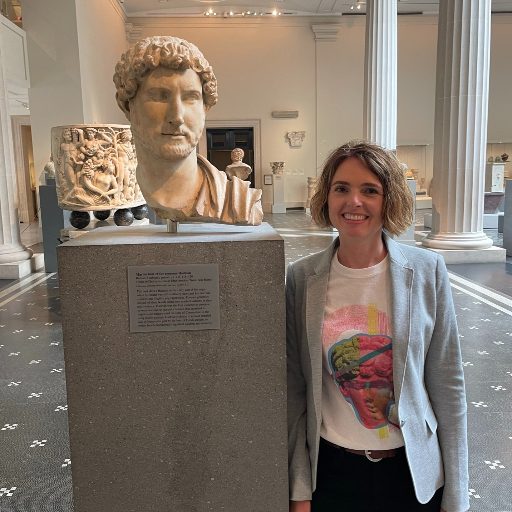
#RomanSiteSaturday - The Sacred Area of Largo di Torre Argentina is one of Rome’s most important Republican-period archaeological complexes. Discovered during demolition work in 1926, it preserves four temples, conventionally labelled A–D because their precise identifications remain uncertain.


 @archaeohawke.bsky.social
Forum dedication with titles of Hadrian, from Wroxeter - 129-130AD. The town had friends in high places.
'holding tribunician power for the fourteenth time, consul three times, Father of the Fatherland, the Civitas of the Cornovii.'
#History #Archaeology
 @shirleyrl.bsky.social
Our 56th Wedding Anniversary today and we're celebrating with our son @jackjl.bsky.social - high up in the #LakeDistrict at #HardknottPass #Romans #RomanSiteSaturday
 @roamintheempire.bsky.social
New post this week! The second and final part on ancient Kisamos finishes up with necropoli an an ancient road, and a great museum with a couple of top tier mosaics, among other objects:
www.roamintheempire.com/index.php/20...
#RomanSiteSaturday #Archaeology #RomanArchaeology #AncientBlueSky🏺
@druidtombraider.bsky.socialThe Ancestors' Cult Hall of the family of Opramoas, Rhodiapolis, Lycia, Türkiye; courtesy of Carole Raddato. #RomanSiteSaturday #RomanArchaeology #Archaeology
 @colinruneckles.bsky.social
By sheer coincidence I am going back seven years today when I turned 60 and went to see the Oppidum d'Entremont so this is my #RomanSiteSaturday.
So I spent my birthday in a field with absolutely nobody else around. As one does.
 @durotrigesdig.bsky.social
The multipurpose Maumbury Rings, Dorchester #Dorset
A Roman amphitheatre created in the late 1st century AD
Built out of the remains of a 3rd millenium BC Late Neolithic henge
Modified for artillery use in the 17th century
Used in the 18th century for execution
📷 Sept 2025
 @formerlytankiemike.bsky.social
The Roman Fortlet/Signal Station above the Valley of Stones, Dorset.
Recently cleared of bracken.
Situated on Black Down, it has line of site to Durnovaria and north-west to the known Roman fort on Waddon Hill.
#RomanSiteSaturday #Archaeology
#ValleyofStones
 @ullamr.bsky.social
The Fosse Way is a Roman road in Britain that ran from Exeter to Lincoln. It was built during the earliest phase of the Roman occupation. It once marked the frontier of the empire's British province. This photo is from the Albion Endeby excavations south of Leicester (Ratae). #RomanSiteSaturday
 @sistoryhistory.bsky.social
Chesters Roman Fort on Hadrian's Wall - surely the most beautiful spot for a bathhouse 🛁💧?
Happy #romansitesaturday 🩷!
#hadrianswall #romanbritain #skystorians #archaeology #romanmilitary