You can explore the collection by visiting: www.nationaltrustcollections.org.uk
Or read more about the archaeological collections here: www.nationaltrustcollections.org.uk/article/arch...

@nattrustarch.bsky.social
Sharing information about archaeology at National Trust places across England, Wales and Northern Ireland
@nattrustarch.bsky.socialYou can explore the collection by visiting: www.nationaltrustcollections.org.uk
Or read more about the archaeological collections here: www.nationaltrustcollections.org.uk/article/arch...
@nattrustarch.bsky.socialThe collections showcase all aspects of past daily life: A dress fastener from Chedworth Roman Villa A Bronze Age barbed and tanged flint arrowhead from Calke Abbey A 6th century CE Byzantine bronze bucket found at Sutton Hoo A Midlands Yellow Ware moulded head from a cup from Tattershall Castle


 @nattrustarch.bsky.social
Last week we shared a post on archaeological archives, but did you know there’s a whole online catalogue you can explore?
National Trust Collections provides opportunities to search the over 1.1 million artefacts in our care, whether by property, category, or date.
Perfect for #FindsFriday!
 @nattrustarch.bsky.social
By determining extent & depth, we can plan management & conservation actions both for nature and heritage! There could not be a more inspiring location to do science while taking us on a journey of discovery guided by Newton’s teaching "What we know is a drop, what we don’t know is an ocean." 🍎
 @nattrustarch.bsky.social
Did you know that Ground Penetrating Radar can be used to detect more than archaeology? Working with @nationaltrust.org.uk Tree Advisors, Woolsthorpe Manor volunteers & Viviana (NT Archaeologist) have been using GPR to study the root system of the tree that inspired Isaac Newton.
#LincolnshireDay 🍎

 @nattrustarch.bsky.social
Have you noticed any displays of archaeological finds at National Trust properties? We’d love to see any photos you might have!
@nattrustarch.bsky.socialYesterday, SW archaeologists Steve and Cat spent the day with volunteers Jackie and Meg to review, re-box and unlock some of the potential of these finds. They discovered everything from prehistoric flint tools to modern glass bottles from a range of properties across the South West.
 @nattrustarch.bsky.social
Some of these finds may be sent to specialists for analysis or conservation, but many are kept in dedicated stores at National Trust properties, full of research potential or ready to bring out for displays for visitors, or for events such as Festival of Archaeology.
 @nattrustarch.bsky.social
Our archaeologists then take the time to process the results of the surveys, draw up plans and write reports, and there’s often a considerable amount of finds to process. They'll wash, count, weigh, record and place into appropriate containers for storage, usually with the help of volunteers.
@nattrustarch.bsky.socialWe certainly enjoy our time #outinthefield, whether that’s undertaking geophysical surveys, building recording, walkover surveys, or excavation (among many other things!), but that’s not the end of the story.
What happens to all the 'stuff' we find?

 @drtobydriver.bsky.socialReposted by @nattrustarch.bsky.social
For #HillfortsWednesday the enormous, but heavily eroded, coastal promontory fort at Porth y rhaw, Pembrokeshire, in the care of @nattrustarch.bsky.social 🤩
The 5 metre+ high ramparts are among the most massive anywhere in west Wales. Excavations have revealed a long occupation
📷 My own, Saturday
 @nattrustarch.bsky.social
Find out more through NT Heritage Records Online:
heritagerecords.nationaltrust.org.uk/HBSMR/MonRec...
or by visiting Winchester Archaeology Group's website: www.warg.org.uk
@nattrustarch.bsky.social"And sometimes, when we stop and think, we remember how humbling it is to learn about the people who came before us - who will never have a name, or a face, but who have left their marks in the landscape in ways that continue to tantalise and inspire our quest for knowledge and discovery."
@nattrustarch.bsky.social"Being in the field is always so much fun, because the people who want to be there have the same passions for discovery, learning and sharing stories with others. It’s a bonding experience to be part of a team on a collective journey of discovery and I always feel so grateful that this is my job."
 @nattrustarch.bsky.social
"To work alongside teams of dedicated volunteers, to be part of that moment in the story of understanding these barrows, and these children who were placed carefully within Barrow One, was a very humbling experience."
@nattrustarch.bsky.social"Often, with pressures of commercial development or climate change, human remains need to be removed to prevent total loss or destruction and the speed with which we need to conduct excavations can cause us to disconnect in our minds the remains from their human embodiment."
@nattrustarch.bsky.social"To mention the labourers by name, and the touching reburial with hand-inscribed tribute, sheds a far more human light than we sometimes give to antiquarians. It also reminds us, as modern archaeologists, that human remains, however old, were people just like us who mattered to those around them."
@nattrustarch.bsky.social"Milner, perhaps due to his clerical status, reinterred the human remains, covering them with small mound of flints and along with a small lead plaque onto which he inscribed the date of excavation, the labourers’ names ‘Stanley Elliott & Merritt’ as well as the word ‘VALE’, a Latin ‘farewell’."
@nattrustarch.bsky.social"Barrow One was investigated in the 1930’s by the Rev. A.B. Milner & archaeologist Samuel Winbolt, who, with the help of 2 labourers, discovered the remains of an oval pit burial, lined & covered with flints, and containing the cremated remains of an infant and a juvenile and a single flint knife."
 @nattrustarch.bsky.social
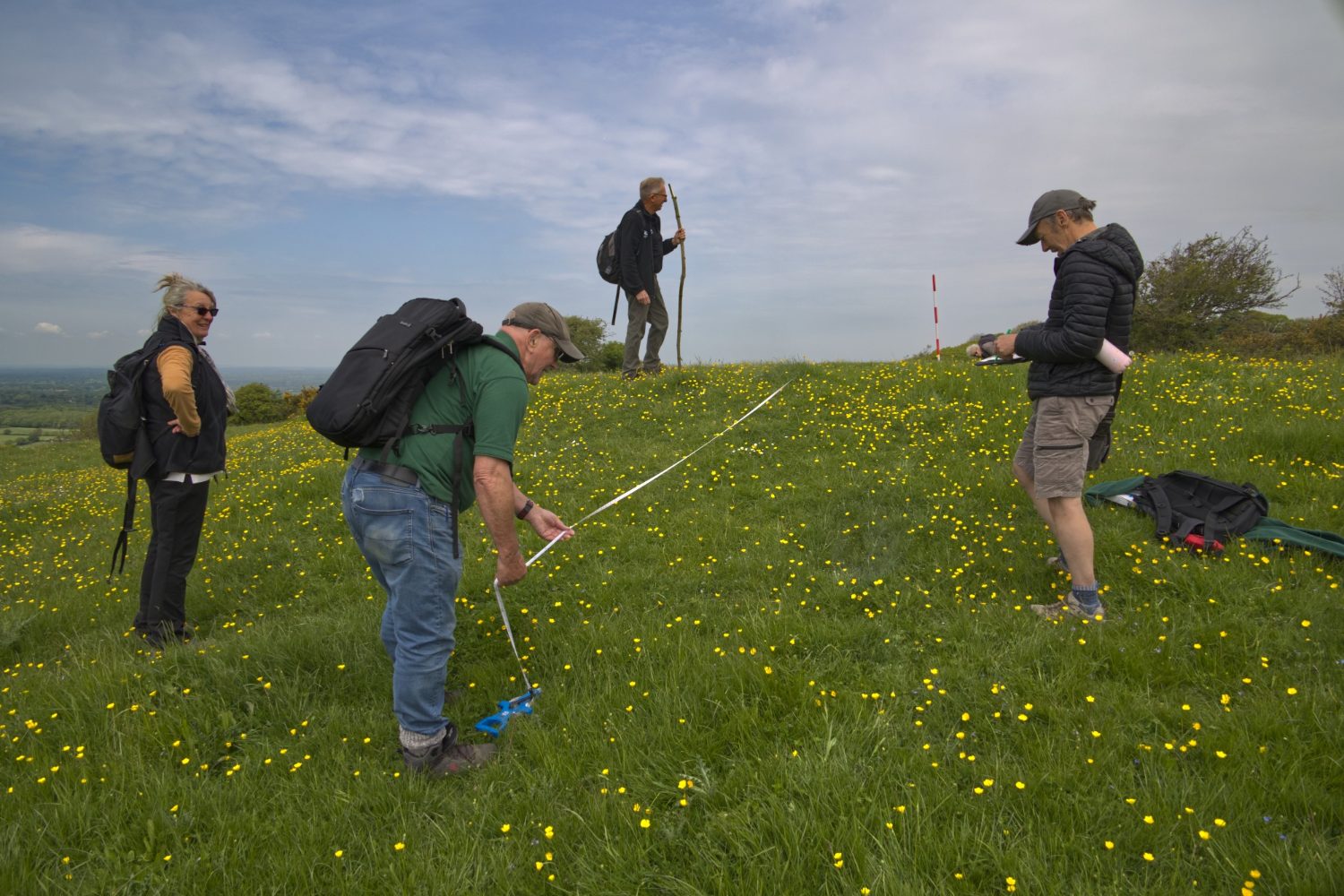
"But recently I was able to help out briefly on one of our current excavations at Hinton Ampner, run by the Winchester Archaeology Group (WARG) in conjunction with HART volunteers."