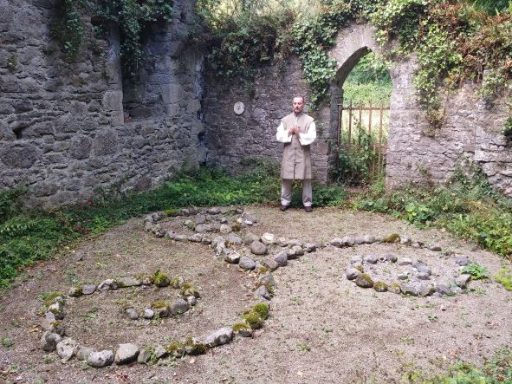
#FindsFriday heading north this morning to the magical island of Ynys Mon/Anglesey to continue the search around Llyn Cerrig Bach votive lake with Op Nightingale & good friends & colleagues @richardosgood.bsky.social & @archaedelle.bsky.social 🧙

#FindsFriday heading north this morning to the magical island of Ynys Mon/Anglesey to continue the search around Llyn Cerrig Bach votive lake with Op Nightingale & good friends & colleagues @richardosgood.bsky.social & @archaedelle.bsky.social 🧙
#FindsFriday with some of the huge numbers of Neolithic finds at the Musée des tumulus de Bougon 🇫🇷
See more from the Loire & central France in the episode >>>
www.youtube.com/watch?v=U-Cp...
#FindsFriday The nails left behind from a pair of Roman sandals. Really clear when you lay them out like this!
Found near Clunia Sulpicia, Roman town in northern Spain
📍Burgos Museum, Spain
📸 Me 🏺 #archaeology
Thinking back to February when a team from @bumaritime.bsky.social and @nattrustarch.bsky.social excavated and lifted a piece of a 17th cargo vessel (the Fame of Hoorn) from the sand of Studland Bay #Dorset
With children's play shovels 👍
A very rare for Wirral Lower Palaeolithic Clactonian c.421,000-412,000 BC flint flake backed knife 58.8x38.4mm. Appears to be a left-handed use tool. The large notched flake removal to the left forming a grip. Right side edge has retouch.
#FindsFriday #FlintFriday #Palaeolithic #Archaeology #Wirral
This Roman coin is mule, or hybrid, of two different types. The obverse is a CONSTANTINOPOLIS type and the reverse is VRBS ROMA. Mules occur when dies from different coins get mixed up at the mint or by contemporary counterfeiters. #FindsFriday finds.org.uk/pas/recorded...
The Sutton Hoo purse lid which was discovered in 1939 as part of the Anglo-Saxon ship burial at Sutton Hoo, near Woodbridge in Suffolk. Dating to the early 7th century, the purse lid is now part of the collections at the British Museum. 📸 My own #FindsFriday #SuttonHoo
A bronze butterfly-shaped boss, originally at centre of a shield helping protect the grip
The only part of an Iron Age wooden shield to survive 2000 years in the ground
Buried with its last owner
Found at North Bersted West Sussex. Now in the Chichester #Novium
📷 March 2026
This is a post-medieval cufflink fragment featuring Prince William, Duke of Cumberland. He was a British military commander best known for crushing the Jacobite Rising at the Battle of Culloden in 1746 and for his ruthless treatment of rebel forces. #FindsFriday finds.org.uk/pas/recorded...
Another great find from the sea
Heather and Liv from our maritime unit discovered this grindstone during a circle search near the 13th century Mortar Ship Wreck
Such stones were rotated to sharpen tools and are known from the 9th century
Could this be contemporary with the wreck?
#FindsFriday: `Thousands of pits from which iron ore was extracted, large-scale deforestation and a heavily fortified, sprawling #Celtic settlement: this is roughly how one can picture the area around what is now Oberpullendorf in Burgenland 2,000 years ago […]
#FindsFriday: `Thousands of pits from which iron ore was extracted, large-scale deforestation and a heavily fortified, sprawling #Celtic settlement: this is roughly how one can picture the area around what is now Oberpullendorf in Burgenland 2,000 years ago: www.derstandard.at/s...
Ornate Saxon copper disc brooch decorated with gold and garnets, AD 650-670.
It must have been a treasured possession!
From Floral Street, Covent Garden, once the heart of ‘Lundenwic’, the early Saxon town of London.
Museum of London 📷 by me
#FindsFriday #Celtic #IronAge: `The Gauls‘ use of wood demonstrates their technological skills. It ist believed that the extrordinary machinery discovered at the bottom of a 18m deep well at the settlement of Saint-Symphorien was used to pump water. The device […]
#FindsFriday #Celtic #IronAge: `The Gauls‘ use of wood demonstrates their technological skills. It ist believed that the extrordinary machinery discovered at the bottom of a 18m deep well at the settlement of Saint-Symphorien was used to pump water.
1/2
#FindsFriday or me leaving work on Friday 🐻
‘Fragmentary Mosaic Floor with Bear Hunt, which is featured in a chapter of our upcoming publication Late Antique Egyptian Fabrics in a Scandinavian Collection
4th century A.D.
Unknown artist/maker
Image source: www.getty.edu/art/collecti...
Very happy that our very own @rmoudheden.bsky.social ‘Krijn’, the Neanderthal from the North Sea made the cover of National Geographic Historia 🌊 ! Reconstruction by Kennis and Kennis. #FindsFriday
#FindsFriday #FerrousFriday #Celtic: The „Druid Crown“ from Roseldorf, Lower Austria, is the only known example of a ceremonial headdress found outside England or Ireland that was made of iron. Despite the iron material of this Roseldorf specimen, it should by […]
#FindsFriday #FerrousFriday #Celtic: The „Druid Crown“ from Roseldorf, Lower Austria, is the only known example of a ceremonial headdress found outside England or Ireland that was made of iron.
1/2