Grilled Cheese

ExploreLog inSign up
Terms of UsePrivacy PolicyCommunity StandardsHelpGet the app

Grilled Cheese is a product of Village Compute

Version devBuilt at: 2026-10-10 01:38:52 EDT

Explore

PostsPeople
LatestRanked
Load more
@laurajg.bsky.socialOct 9, 2026, 9:52 PM

By Zinaida Serebriakova (1884-1967), Green Autumn Landscape, 1908, oil on canvas, 43.4 x 45 cm, Tretyakov Gallery, Moscow. #art #womanartist #womenartists #painting #oilpainting

From Byron’s Muse on Wordpress: ‘“Green Autumn Landscape”, shows an early autumn scene. Nearly the entire canvas shows a vast field stretching on and on in long, neverending vertical lines. Three windmills break up the space for the moment but then the fields spread on more and more in the distance. The sky is light grey and quiet. No crows are restlessly, nervously flying low above the fields, but still there is a sense of foreboding because we know that the fogs will soon descent and hover above the fields, that the green that is so pleasant to the eyes will turn to brown soil. To me, this painting represents autumn’s sense of desolation, painted in a very simple but beautiful way. It also brings to mind many landscapes by Vincent Van Gogh.”
@kimtestone.bsky.socialOct 9, 2026, 7:14 PM

Join me live on Twitch today for a signed mini print giveaway!
www.twitch.tv/kim_testone_artist

#art #painting #noai #acrylicpainting #artwork #blueskyart #traditionalart #livestream #twitch #blueskyartshow #traditionalpainting #twitchstream #realism #hyperrealism #stilllife #chatting #womanartist

A woman sitting at an easel in her art studio with a pallet on her lap painting.  She has several realism paintings hanging on the wall behind her of various sugar cookies in whimsical poses.
@mdstamper.bsky.socialOct 8, 2026, 7:40 PM

“Jazz Dancers” by Aldonia R. Bailey (American) - Acrylic on canvas / Possibly 1974 - San Bernardino County Museum (Redlands, California) #WomenInArt #AldoniaBailey #Bailey #BlackArt #AfricanAmericanArt #JazzArt #DanceInArt #BlackRenaissance #art #artText #arte #WomensArt #WomanArtist #WomenArtists

American artist Aldonia Bailey described “Jazz Dancers” as showing dancers “swaying to the music” while people enjoy jazz in Central Park. Rather than isolate a single performer, she makes collective movement the painting’s subject as six women seem linked by an invisible beat, their repeating postures carrying the eye across the canvas like notes in a melodic line. Bailey’s saturated color, simplified forms, and energetic brushwork privilege atmosphere and memory over strict realism. 

The six Black women sweep diagonally across a vivid green lawn, their bodies leaning backward and sideways as though caught in the same musical phrase. Bailey dresses them in long, brilliantly patterned pink, blue, yellow-green, orange, and deep red skirts paired with pale sleeveless tops, jewelry, and hair ornaments. Their elongated poses turn movement into rhythm so arms bend, shoulders tilt, and skirts flare as the dancers sway together. Behind them, small pavilions painted in pink, blue, and white punctuate a park filled with loosely rendered figures. Tall palms and dense trees frame a glowing yellow-orange sky, giving the scene the warmth and bustle of an outdoor summer festival.

This is jazz experienced through motion, community, and pleasure. The work also participates in a long tradition of Black artists representing music and dance as spaces of creativity, social connection, and cultural continuity. Bailey, a Louisiana-born artist long active in Southern California, has repeatedly returned to jazz, dancers, family, and Black everyday life throughout her practice. Her inscription appears to date the painting to 1974, which would make it an unusually early work in her career. The painting appeared in the San Bernardino County Museum’s 2026 exhibition Black Renaissance, where its exuberant celebration of Black music, movement, and communal life resonated with the exhibition’s dialogue between the legacy of the Harlem Renaissance and contemporary Black creativity.
@erinkatearcher.bsky.socialOct 8, 2026, 6:01 PM

dragon in progress #traditionalart #womanartist #fantasy #fantasyart #threshingday

@erinkatearcher.bsky.socialOct 7, 2026, 4:56 PM

new painting in progress ✧ #traditionalart #witches #fantasy #womanartist

@mdstamper.bsky.socialOct 6, 2026, 9:34 PM

“Green Tea” by Leonora Carrington (British) - Oil on canvas / 1942 - Museum of Modern Art (New York, NY) #WomenInArt #WomensArt #LeonoraCarrington #Carrington #Surrealism #BritishArt #MoMA #ModernArt #art #artText #arte #painting #BritishArtist #MuseumOfModernArt #1940sArt #WomanArtist #WomenArtists

British artist Leonora Carrington painted “Green Tea” during a turbulent period of displacement and reinvention. After Nazi authorities imprisoned her partner, artist Max Ernst, during World War II, Carrington fled France for Spain. There she experienced a psychological crisis and was confined against her will in a psychiatric institution in Santander, where she underwent harsh treatments. She later escaped her family’s plans for further institutionalization, traveled to New York, and painted this work shortly afterward.

Across a strangely manicured green landscape, a solitary woman stands wrapped from shoulders to ankles in black-and-white, cowhide-like fabric. Her arms disappear beneath the constricting folds, while her pale, masklike face and bare feet remain exposed. Beside her, four small antlered heads rise from a purple vessel. Farther right, a reddish doglike creature and a white horse are tethered to slender trees that seem to grow from their own elongated tails. Behind them stretches an intricate countryside of hedges, paths, miniature trees, towers, and distant fantastic structures beneath a blue sky. Along the bottom edge, the earth appears sliced open, revealing a shadowy underground realm inhabited by bats, birds, bodies, and mysterious cocoons.

The bound central figure has often been interpreted as Carrington herself. Its enveloping garment evokes both protection and restraint, making the surrounding open landscape feel paradoxically inaccessible. The white horse carries particular autobiographical resonance: horses recur throughout Carrington’s art and writing as figures of freedom, transformation, and rebellious energy. Here, however, even the horse is chained.

The serene English-looking countryside coexists with impossible animals, ritualistic objects, and an ominous world literally beneath the surface. The painting embodies a central Surrealist impulse: ordinary appearances conceal unruly inner realities.
@lesliedeilart.bsky.socialOct 6, 2026, 12:08 AM

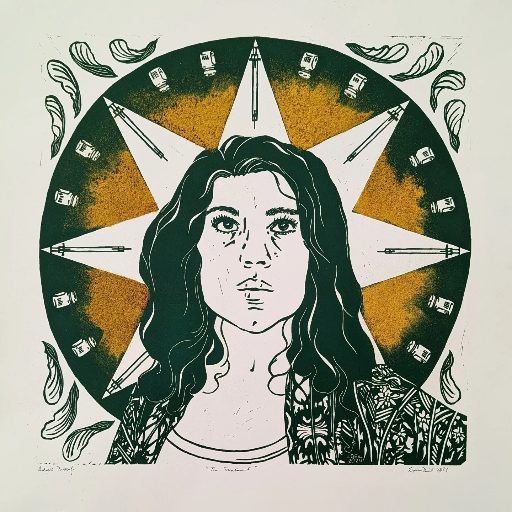
I'm getting older, as we all do. With this season of life, I force myself to do a self portrait every year. I'm finally getting around to doing this year's portrait.

#selfportrait #womanartist #midlife #linocut #studiotime #art

@mdstamper.bsky.socialOct 5, 2026, 2:56 PM

“afro.died, T.” by Rozeal. (American) - Acrylic, pen, ink, marker, and graphite on birch plywood panel / 2011 - National Gallery of Art (Washington, DC) #WomenInArt #Rozeal #art #artText #WomenArtists #BlackArt #AfricanAmericanArt #AfricanAmericanArtist #IonaRozealBrown #ContemporaryArt #WomanArtist

American artist Rozeal. (Iona Rozeal Brown) created this work after becoming fascinated by ganguro, a Japanese youth style associated with deeply tanned skin, blond or bleached hair, dramatic makeup, and fashion shaped in part by African American hip-hop culture. She combines that contemporary reference with the visual language of ukiyo-e and bijin-ga images of fashionable women, producing a deliberately unstable hybrid of Japanese, Black American, and Western imagery. 

A glamorous woman reclines diagonally across the panel, gathering a long fall of blond hair in both hands. Her skin is partly covered in dripping brown pigment that leaves lighter areas visible beneath, while dark roots, red lips, elongated scarlet nails, pearls, and a green robe trimmed with white fur heighten the sense of deliberate self-fashioning. Behind her, large circles resembling records overlap with angular lines and repeated “BACK AND FORTH” text. At lower left and across her thigh, koi, curling blue waves, patterned cushions, and flattened decorative space evoke Japanese print traditions. Her lowered gaze makes the scene feel less like a posed portrait than a private moment of transformation.

The brown color appears applied rather than natural, making racial transformation visible and raising questions about imitation, appropriation, and the unequal consequences of “putting on” signs of Blackness. The repeated phrase “BACK AND FORTH” reinforces that cultural movement and also recalls Aaliyah’s 1994 song. The title is another layered exchange as “afro.died, T.” sounds like Aphrodite, goddess of love and beauty, while its written form suggests an “afro” dying or disappearing. Rozeal. does not reduce cultural borrowing to a simple accusation. Instead, she makes the painting seductive, witty, and uneasy at once, asking what is gained, distorted, or erased when beauty and identity travel across cultures.
@mdstamper.bsky.socialOct 4, 2026, 5:59 PM

“Africa” by Loïs Mailou Jones (American) – Oil on canvas board / 1935 – The Johnson Collection (Spartanburg, South Carolina) #WomenInArt #WomenArtists
#LoisMailouJones #BlackArt #AfricanAmericanArt #TheJohnsonCollection #artText #LoïsMailouJones #WomensArt #WomanArtist #africa #HarlemRenaissance


American artist Loïs Mailou Jones painted “Africa” in 1935, five years after joining the faculty of Howard University, where she would teach for nearly half a century. Colleagues there encouraged the Boston-born artist to challenge racist stereotypes and explore African heritage, and this painting reflects that developing engagement. 

Three monumental Black figures fill the composition, pressed close to the picture plane against a glowing yellow-orange background and broad tropical leaves. The central woman dominates the upper half of the painting, her long, symmetrical face framed by dark hair and accented with green, almond-shaped eyes. She wears dangling gold earrings, a necklace of pale tusks or teeth, and patterned fabric draped across one shoulder. Below her, two additional figures overlap across the foreground. At left, a figure tilts inward beneath stacked gold neck rings and an elaborate spiral earring. At right, another face reclines horizontally, partially obscuring the boldly striped garment at center. Deep browns, greens, golds, cream, blue, and red repeat across skin, jewelry, foliage, and textiles, creating a tightly orchestrated pattern. 

The elongated faces, simplified features, still expressions, and compressed space give the figures a sculptural presence that evokes African masks, an aesthetic vocabulary Jones would return to throughout her career. At the same time, the work displays her exceptional command of decorative pattern and color, skills rooted partly in her early training as a textile designer. 

The Johnson Collection describes the painting’s jewel-like palette, patterned cloth, jewelry, and mask-inspired faces as central to Jones’s response to calls for Black artists to engage more directly with African cultural traditions.
@thezenoftrueart.bsky.socialOct 4, 2026, 5:49 PM

Gabriele Munter, "Flower and Fruit Still Life," oil on cardboard, c.1940-50; photo: Ketterer Kunst. #art #arte #gabrielemunter #modernart #stilllife #abstractstilllife #flowers #femaleartist #womanartist #colorfulart #museum #paintings #peintures #kunst #museum #artgallery

@sharonprigan.bsky.socialOct 4, 2026, 5:02 PM

So, I was watching him create his patchwork square, and I couldn't help but notice those beautiful fabric strips calling my name. The waves of inspiration just washed over me!
www.priganart.com/post/brown-w...

#quiltsky #sewsky #womanartist #artquilt

brown fabric strips on a table and someone sitting at a sewing machinebrown wave landscape patchwork art quiltquilting a brown wave landscape patchwork art quilt
brown wave pieced and quilted art quilt
@mdstamper.bsky.socialOct 3, 2026, 6:54 PM

“El Último Hilo (The Last Thread)” by Karla de Lara (Mexican) – “de Lara” Technique with ink, wax & high gloss / 2026 – Museo de las Américas (Denver, Colorado) #WomenInArt #KarlaDeLara #MexicanArt #arte #ContemporaryArt #art #artText #MuseoDeLasAmericas #Surrealism #Symbolism #DeLara #WomanArtist

Mexican artist Karla de Lara’s “The Last Thread” turns separation into something more complicated than rupture. The artist placed a Spanish-language text of her own beside the painting, making the written word an integral companion to the image. In it, she describes two souls recognizing themselves as independent and confronting memories, wounds, inherited affections, guilt, and patterns carried through generations. Separation requires returning to each other what does not belong to oneself while reclaiming one’s own limits, identity, and independence.

That story illuminates the painting’s opposing realms. Two elongated women face one another within a fantastical architectural world divided between fire and night. At left, a red-haired figure rises from a dense landscape of rust, crimson, black, tangled branches, and glowing lanterns. At right, her pale, silver-haired counterpart stands amid moonlight, blue water, stars, columns, and delicate white flowers. Their outstretched hands nearly meet around a radiant sphere at the painting’s center. Gold-and-white tendrils spiral outward from it, visually binding their contrasting worlds. The women’s sweeping gowns echo the curling smoke, water, hair, and vines around them, while small cages, masks, celestial forms, and reflections create a dreamlike environment of confinement, memory, release, and transformation.

The fiery figure and the luminous blue figure are not simply adversaries, but intertwined identities whose experiences have shaped one another. The glowing energy between the women is not a bond that must be violently severed, but one that can change form.

Separating does not always mean losing one another because memory, learning, and “amar desde la libertad” can forge love from freedom. The painting speaks to me of boundaries and attachment across generations. Fire does not extinguish water, and night does not erase light. Instead, the two women remain connected at the very moment each becomes fully herself.
@yalepress.bsky.socialOct 3, 2026, 4:07 PM

Mark your calendars & be sure to RSVP! Nicholas Fox Weber will be in NY on Oct 21 to talk about his biography of the one and only #AnniAlbers
#bookevent #arthistory #biography #womanartist

@sharonprigan.bsky.socialSep 30, 2026, 3:00 PM

This is also a project. Sorting buttons for a button jewelry class.
#sewsky #upcycledart #womanartist

@sharonprigan.bsky.socialSep 27, 2026, 12:58 PM

When I see pre cut fabric strips waves call my name
#quiltsky #sewsky #womanartist #upcycledart #quiltart

@laurajg.bsky.socialSep 27, 2026, 12:48 AM

Excerpt: “In some ways defiantly modern, Fini is also a character who seems to sit outside of time.” #art #womanartist #womenartists #surrealism
www.artnews.com/art-in-ameri...

@elainefogel.bsky.socialSep 23, 2026, 9:43 PM

🍂Autumn is here! Do you look forward to the trees changing color? elainefogelart.com/product/autu... 9” W x 12” H ON SALE! #autumn #paintings #sharingart #artcollector #wallart #womanartist

@thezenoftrueart.bsky.socialSep 21, 2026, 9:14 PM

Georgia O'Keeffe, "Abstraction Blue," oil on canvas, 1927; Museum of Modern Art (MoMA), New York. #art #arte #modernart #abstractart #flowers #flowerart #abstractflowers #okeeffe #georgiaokeeffe #womanartist #paintings #oilpainting #museum #artgallery

@sharonprigan.bsky.socialSep 19, 2026, 7:48 PM

I thought it would be a pendant but its going to be a cuff bracelet. #upcycledart #womanartist #fabricjewelry #sewsky

@thezenoftrueart.bsky.socialSep 19, 2026, 4:31 PM

Cary Loopuyt Jurriaans (b.1945), "Ode to Rodie II," oil on linen, nd; photo: Rob Schouten Gallery. #art #arte #modernart #stilllife #stilllifepainting #flowers #flowerpainting #womanartist #femalepainter #flowerpainting #paintings #peintures #kunst #museum #artgallery
