

Grilled Cheese

ExploreLog inSign up
Terms of UsePrivacy PolicyCommunity StandardsHelpGet the app

Grilled Cheese is a product of Village Compute

Version devBuilt at: 2026-10-10 20:13:24 EDT

Explore

PostsPeople
LatestRanked
@patrickkapty.bsky.socialOct 9, 2026, 3:14 PM

Mesoamerican Ballplayer Rattle
ceramic
c. 600-750 CE
Nopiloa culture
Veracruz, Mexico

See ALT for historical info...

#handmade #ceramic #rattle #accompaniment #ballplayer #Mesoamerican #BallGame #lifeordeath #Nopiloa #culture #Veracruz #Mexico #precolumbian #prehispanic #ancientart #art #sculpture

Originating around 1500 B.C. among the Olmec, the Mesoamerican ballgame was the first team sport in human history. While there were localized variations in the game that was played from New Mexico to Honduras to the Caribbean, there were also many consistent features. Players' hands were only used to put the ball into play, after which it was deflected with the hips, knees, elbows, feet, and head. At the end of the game, players from the losing team were sometimes sacrificed in accordance with the belief that human bloodletting and sacrifice were essential practices for maintaining agricultural fertility and cosmic order. This rattle in the form of ballplayer from Veracruz (Gulf Coast of Mexico) wears typical ballgame equipment including a u-shaped yoke around his hips, a kneepad (yugito), and a helmet with a harpy eagle crest on top. Carnivorous birds like eagles were commonly associated with the ballgame because of their predatory nature - a desirable trait for a successful player in this life or death sport. Rattles like this one, as well as ceramic whistles, conch shell horns and drums provided accompaniment during the ballgame.

Mesoamerican Ballplayer Rattle
ceramic
c. 600-750 CE
Nopiloa culture
Veracruz, Mexico
@basilgentleman.bsky.socialOct 9, 2026, 10:32 AM

Work for my #Mesoamerican exhibition ✨
Step 1: I start off by drawing with Faber-Castell black pens.
Step 2: Next, I colour the drawings with Faber-Castell Pitt Artist Pens or Polychromos pencils.
Step 3: Finally, I apply Sennelier acrylic paint to finish the painting.
#aztec #art #drawings #artist

@patrickkapty.bsky.socialOct 5, 2026, 3:26 PM

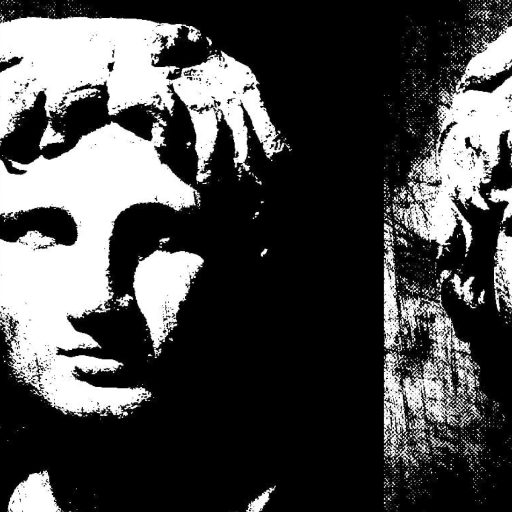
Portrait Head
Architectural Fragment
stucco, paint
c. 300-900 CE
Maya culture
Uxmal, Mexico

#handmade #stucco #paint #portraithead #head #architecturalfragment #MayaCulture #Uxmal #Mexico
#precolumbian #prehispanic #Mesoamerican #ancientart #art #sculpture #stuccoart #MayanStucco #precolumbianart

It is likely that this modeled stucco head from the Uxmal site is part of an architectural decoration and that it refers to a member of the ruling family or honors an ancestor. It is associated with the building known as the Governor's House, the main architectural theme of which is a series of overlapping figure heads carved in stone representing the god of rain, Chaak. In impressive temples and palaces, jutting sculptures were an important part of the architectural design, often representing mythological beings or rulers. Inscriptions, in addition to being decorative, also sent various messages to the observer.
Modeled stucco - lime-based plaster - is one of the great art forms developed in pre-Columbian times. Entire cities were covered with stucco. Architectural sculpture such as figure heads, free-standing sculpture, wall coatings, floors-all were made with stucco. The beautifully made face on this piece can be seen as an ancient portrait, with adornments such as ear ornaments and a headband, but the body paint stands out, probably indicating ceremonial activities. Unfortunately, due to its fragility, stucco art - especially on the exterior of structures - was the first to
erode or be destroyed after buildings were abandoned. Because of this, stucco representations are not abundant in collections of Maya artifacts. This piece should be regarded as one of the most significant, because of its color and its creator's artistic skill.
-Edgar Suyuc (Kaqchikel Maya)
@patrickkapty.bsky.socialOct 4, 2026, 3:27 PM

The Acrobat of Colima Vessel
terracotta
c. 200 BCE to 300 CE
Colima culture
Western Mexico, Colima

#handmade #terracotta #vessel #AcrobatofColima #Colima #culture #precolumbian #mesoamerican #pottery #precolumbianpottery #acrobat #art #ancientart #sculpture #shafttombtradition #burial #afterlife

Dating to c. 200 BC-AD 300, this remarkable ceramic vessel from Colima, western Mexico, takes the form of a male acrobat performing an extraordinary contortion. Rather than simply decorating the vessel with a human figure, the ancient artist transformed the acrobat's body into the vessel itself, with his inverted head resting below his torso and his legs dramatically curved above him. The sculpture captures a fleeting display of flexibility, balance and physical skill in permanent clay and reflects the lively interest in the human body characteristic of the ceramic traditions of ancient West Mexico.
The vessel is today held in The Metropolitan Museum of Art, New York, as part of the Michael C.
Rockefeller Memorial Collection.
The pre-Columbian Colima culture was an ancient Mesoamerican society that thrived in western Mexico (primarily in the modern state of Colima, as well as parts of Jalisco and Michoacán) from roughly 300 BCE to 600 CE, and is famous for its rich Western Mexico shaft tomb tradition.
The people lived in small agricultural villages and regional chiefdoms rather than massive imperial centers. They farmed maize, beans, squash, and chili peppers in fertile volcanic valleys.
Unlike central Mexican groups, they built modest structures on platforms using river boulders and wattle-and-daub, though regional centers like La Campana featured larger ceremonial mounds.
Colima culture is globally celebrated for its burnished, reddish-brown terracotta pottery. Artisans crafted hollow ceramic figurines with expressive, clean lines and dynamic forms.
@basilgentleman.bsky.socialSep 28, 2026, 2:00 PM

Work for my #Mesoamerican exhibition ✨
Step 1: I start off by drawing with Faber-Castell black pens.
Step 2: Next, I colour the drawings with Faber-Castell Pitt Artist Pens or Polychromos pencils.
Step 3: Finally, I apply Sennelier acrylic paint to finish the painting.
#aztec #mayan #art #drawings

@odsteria.bsky.socialSep 21, 2026, 6:26 AM

For this month's prompt writing challenges, I've used the Yok Turali Raen headcanon I wrote awhile back to build from, and it's been a fun time. If you like Mesoamerican inspired stuff, check it out! ellipsus.com/read/26NDVr9...

#FFXIV #Writing #Mesoamerican #Nahuatl

@patrickkapty.bsky.socialSep 20, 2026, 1:44 PM

Zoomorphic Hacha
carved stone
c. 500-950 CE
Late Classic
Maya culture
Mexico

#handmade #carved #stone #hacha #zoomorphic #transformation #belief #ritual #mesoamerican #ballgame #Maya #culture #mexico #ancientart #ancientsculpture #ritualobject #ceremonial #precolumbian #prehispanic #art #sculpture

In ancient Mesoamerica (particularly in Maya and Classic Veracruz cultures), an hacha (Spanish for "axe") was a critical piece of ceremonial gear associated with the Mesoamerican ballgame. While lightweight wooden versions were likely worn on the players' heavy belts during active matches, these highly detailed stone replicas were carved for ritual displays, architectural integration, or dedication ceremonies.
@a5roseb.bsky.socialSep 13, 2026, 2:19 AM

#RocketsChallenge2026
The Obsidian Harvest
An ancient machine walks the cornfields beneath the watch of a smoking volcano.
#AztecArt #ObsidianAndroid #AncientFuture #Cornfield #Mesoamerican #AIart #AIchallenge #aiartcommunity #aiartist #GenAI #GenerativeArt #SynthArt #BuilderofNightmares

A towering humanoid machine stands in a narrow irrigation channel running through a mature cornfield. Its body is constructed from dark, almost black metal with an obsidian-like sheen, combining exposed mechanical joints, cables, pistons, and intricate armor. The broad torso is covered in overlapping geometric plates and elaborate circular ornaments reminiscent of Mesoamerican decorative forms. A sculpted humanlike face emerges beneath a massive ceremonial-looking headdress integrated into the machinery, with coils, discs, carved patterns, and bundles of cables rising behind the head and shoulders. Long skeletal mechanical arms hang nearly to the water, ending in articulated metal fingers. Thick armored thighs narrow into complex exposed lower legs partially submerged in the reflective channel. To the right, rows of dry golden corn crowd close to the machine. On the left, cultivated wet fields stretch toward weathered stone terraces and ruins overgrown with tall grasses. In the distance, a nearly symmetrical volcanic mountain rises through warm haze, releasing a pale column of smoke into a softly glowing sky. Golden late-day light catches the edges of the black machinery, corn leaves, stonework, and rippling water, blending futuristic engineering with an ancient agricultural landscape.

Keywords:
obsidian android, Mesoamerican armor, cornfield, volcano, irrigation channel, ancient ruins, mechanical humanoid, ceremonial headdress, agriculture, black metal, golden light

AI-generated; use is permitted for non-commercial creative projects. MidJourney, FLUX.1-schnell model via Perchance, Artspace.ai, REVE, Echoform™.
@basilgentleman.bsky.socialSep 9, 2026, 8:15 PM

More work from my exhibition on #Mesoamerica
This exhibition was inspired by my interest in and admiration for Mesoamerican history, mythology and culture.
#aztec #mesoamerican #art #painting #artwork #draw #coloring #precolumbian #aztecs #mayans #artist #mayan #acrylicpainting #drawing