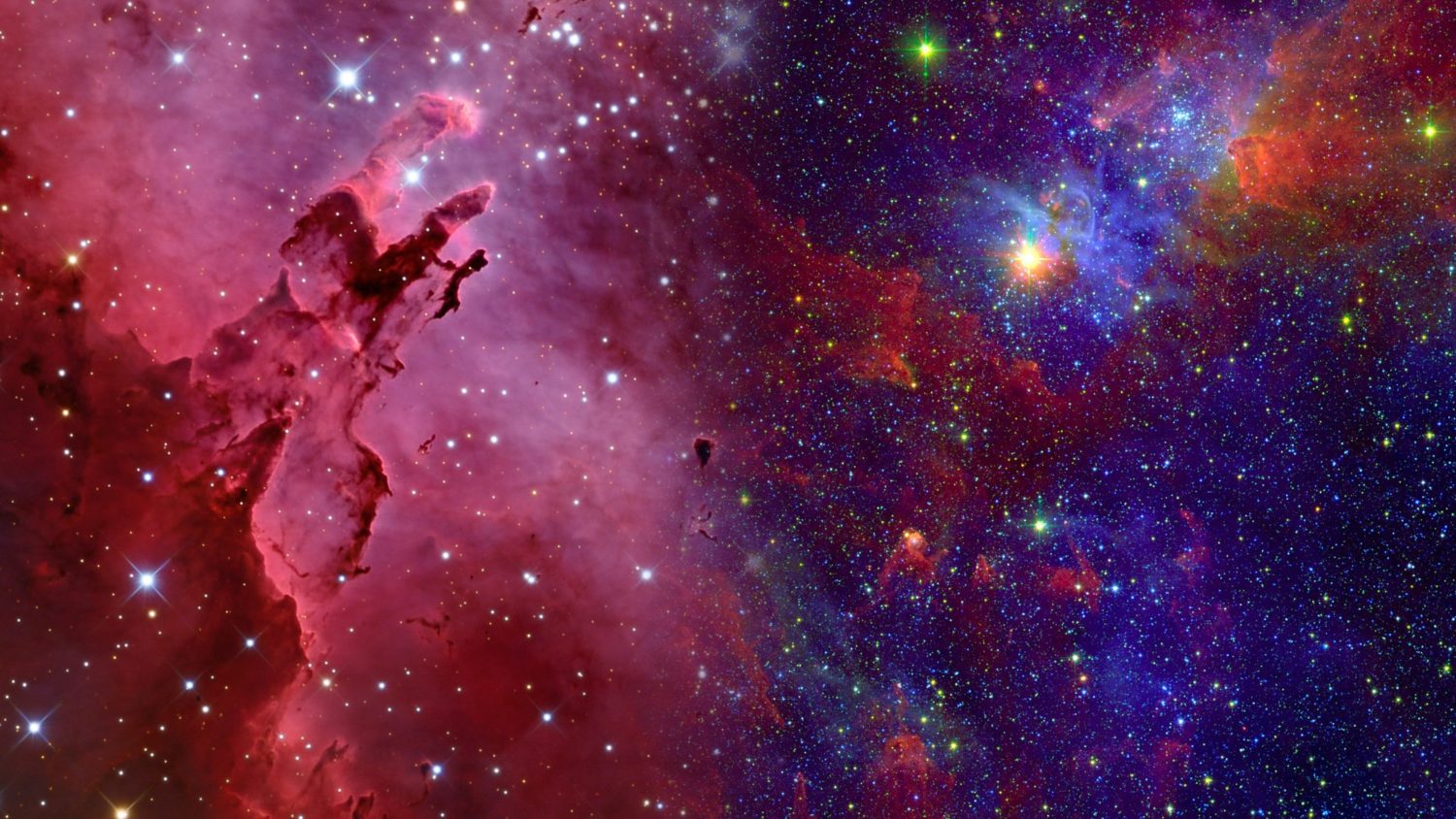
🌕 A fresh lunar crater reveals changes extending far beyond the impact site!
Researcher Tyler M. Powell explains how nighttime temperatures reveal an impact's surprising reach.
Watch the full #SETILive: youtube.com/live/awZUHUa... 🧪 🔭

@setiinstitute.bsky.social
Our mission is to lead humanity’s quest to understand the origins and prevalence of life and intelligence in the universe and share that knowledge.
@setiinstitute.bsky.socialHear more in the latest SETI Live podcast episode, “What JUICE Revealed About Interstellar Comet 3I/ATLAS.” 🎧 Listen wherever you get your podcasts.
@setiinstitute.bsky.socialAn interstellar comet came from another solar system — so how different is it from the comets we already know? In this clip, Dr. Cecilia Tubiana explains that 3I/ATLAS may be an interstellar visitor, but some of its properties look surprisingly familiar. 🧪 🔭 👩🔬
@setiinstitute.bsky.social🌕 A fresh lunar crater reveals changes extending far beyond the impact site!
Researcher Tyler M. Powell explains how nighttime temperatures reveal an impact's surprising reach.
Watch the full #SETILive: youtube.com/live/awZUHUa... 🧪 🔭
@setiinstitute.bsky.socialNot Just Aliens is the SETI Institute’s weekly series featuring scientists exploring astrobiology, heliophysics, planetary science, and more — expanding the search for life beyond Earth.
@setiinstitute.bsky.socialStephanie earned her MS in Physics and Astronomy from San Jose State University in 2023. There, she explored how machine learning could identify phases of ultra-cold atoms in optical lattices, bringing together physics and data-driven techniques.
Learn more: www.seti.org/people/steph...
@setiinstitute.bsky.socialStephanie Striegel is the SETI Institute’s Lead Operations Engineer for the Science Processing Operations Center at NASA Ames Research Center. Her work supports NASA’s TESS mission, helping enable the detection and study of planets beyond our solar system.
#NotJustAliens 🧪 🔭 👩🔬


 @setiinstitute.bsky.social
Could ancient alien technology be hiding in Moon dust? 🌕🔬
A new study proposes searching lunar regolith for microscopic technosignatures that could have crossed interstellar space.
Simon Steel talks with lead author Lewis Pinault on #SETILive.
📅 Oct. 15 | 2:30 pm PDT 🧪 🔭
 @setiinstitute.bsky.social
Today's SETI Live has been rescheduled for next week, Thursday, 15 October, at 2:30 pm PDT / 5:30 pm EDT. We're still talking about searching the Moon for microscopic technosignatures, so please stay tuned for a new announcement and fresh links!
@setiinstitute.bsky.socialCredit: ESA/Webb, NASA & CSA, L. Furtak, S. Fujimoto
Learn more: esawebb.org/images/potm2...
@setiinstitute.bsky.social...more than once in a single galaxy cluster. The lens also acts as a natural magnifying glass: some tiny star-forming regions, only about five light-years across, are magnified more than 300 times, allowing JWST to probe structures that would otherwise be too distant and faint to study.
@setiinstitute.bsky.social...from even more distant galaxies behind it, creating the arcs and repeated images seen throughout the field. Astronomers found two separate systems in which gravitational lensing produces four or more images of the same background galaxy—the first time this rare configuration has been observed...
@setiinstitute.bsky.social#PPOD: Galaxies warp, stretch, and multiply across this view from NASA’s JWST. The golden galaxies belong to the massive galaxy cluster MACS J0454.1-0300, seen as it was about 8 billion years ago. The cluster’s enormous gravity bends spacetime and distorts light... 🧪 🔭
 @setiinstitute.bsky.social
SETI Institute researchers are using the Allen Telescope Array to survey the anti-solar point — a possible shared “Schelling point” where another civilization might expect us to look for a signal.
It’s the ATA’s largest-ever survey. arxiv.org/abs/2610.07065 🧪 🔭 👩🔬
@setiinstitute.bsky.social🌕 A 222-meter crater. Kilometers of changes to the Moon's surface!
Join Franck Marchis and Tyler M. Powell TODAY at 2:30 p.m. PDT to learn what this fresh impact reveals about lunar geology.
 @setiinstitute.bsky.social
Credit: NASA/JPL-Caltech/University of Arizona
Learn more: www.uahirise.org/ESP_092890_1...
@setiinstitute.bsky.socialErosion is now carving the deposits into pits, jagged edges, and intricate patterns, while younger dark ripples of windblown sand and debris have accumulated between them—layering evidence of Mars’s more recent environment over its ancient climate record.
@setiinstitute.bsky.social...suggesting that the same kinds of material were deposited repeatedly over time. Scientists have proposed that the rhythmic layering seen across Arabia Terra may have formed through global climate cycles, including recurring dust storms, perhaps with groundwater also playing a role.
@setiinstitute.bsky.social#PPOD: These strange, intricately eroded deposits in Mars’s Arabia Terra region preserve a record of the planet’s ancient climate. Captured by the HiRISE camera aboard NASA’s Mars Reconnaissance Orbiter, the light-toned layers have similar thicknesses and brightness... 🧪 🔭
 @setiinstitute.bsky.social
Could ancient alien technology be hiding in Moon dust? 🧪 🔭
A new study proposes searching lunar regolith for microscopic technosignatures that could have crossed interstellar space.
@allplanets.bsky.social talks with lead author Dr. Lewis Pinault on a special #SETILive.
📅 Fri., Oct. 9 | 2 pm PDT
 @setiinstitute.bsky.social
Mars’ watery past may be hiding underground.
A study co-authored by SETI Institute affiliate Mohit Melwani Daswani suggests groundwater could have buried carbonate deposits beneath the Martian surface. 🧪 🔭
Read more from @universetoday.com: www.universetoday.com/articles/car...