Grilled Cheese

ExploreLog inSign up

The Partial Historians 🏺

@partialhistorians.bsky.social

3.3k Following5.8k Followers

After surviving exposure at birth, these unconventional academics realised they were destined to found the greatest Ancient Roman History podcast! 🏛📯⚔️

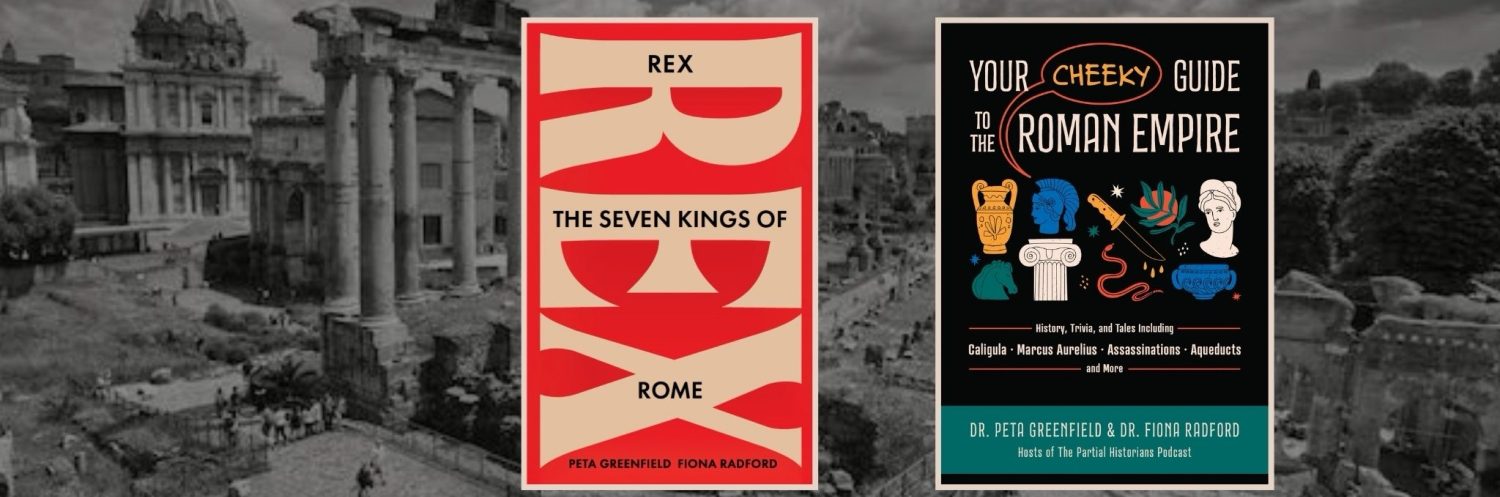
📘‘Your Cheeky Guide to the Roman Empire’ is out now! https://linktr.ee/ThePartialHistorians

PostsRepliesMedia
@partialhistorians.bsky.socialOct 12, 2026, 6:06 PM

The *secrets* must be guarded!

@partialhistorians.bsky.socialOct 12, 2026, 6:05 PM

A fine way to commemorate you’re own black doggo 💜

@partialhistorians.bsky.socialOct 12, 2026, 6:05 PM

Gotta get all the channels somehow 🤣

@anthonymajanlahti.bsky.socialOct 12, 2026, 3:57 PMReposted by @partialhistorians.bsky.social

Before 1777, Falerio Picenus was a nearly perfectly-preserved #Roman town. Then Pius VI’s diggers arrived. For #MosaicMonday, we examine this Antonine-era leopard #emblema, stripped from a private #domus and treated as #spolia in the Vatican's Scala Simonetti. #AncientBluesky 🏺

ROMAN MOSAIC EMBLEMA OF A LEOPARD FROM FALERIO PICENUS, MID-LATE C2 CE. VATICAN MUSEUMS

A Roman mosaic panel featuring a leopard walking left, depicted with brown and ochre tesserae, framed by a guilloche border. Falerio Picenus was a pristine Roman town until 1777, when Pope Pius VI's excavators arrived to furnish the Museo Pio-Clementino. Stripped from a private domus and cemented into the Scala Simonetti as spolia, this emblema invites reflection. Devoid of Dionysian symbols, the leopard is pure physical threat. Yet, frozen in mosaic, it is utterly tamed. For the Roman diners reclining above it, this apex predator was a conversational set-piece about empire, bringing the wild safely into the domestic sphere. Ultimately, the true predator was not the leopard, but the papal excavators. The homeowners were safe from the beast beneath their feet, but Falerio Picenus had no protection from the C18 diggers who tore the town apart to feed the Vatican collections.
@partialhistorians.bsky.socialOct 12, 2026, 10:18 AM

The one question we failed to ask!

@partialhistorians.bsky.socialOct 12, 2026, 10:17 AM

✨Cave Canem✨ We’re not saying this excellent doggo is particularly dangerous, but they are guarding the Casa di Paquius Proculus in Pompeii, so best be careful! Also this doggo comes with a labrys (double axe) and a shield and spear!

#MosaicMonday #AncientRome

This mosaic comes from the Casa di Paquius Proculus in Pompeii. The mosaic depicts a black dog with a red collar chained to a pillar. Also depicted are what look like a labrys (double axe) and a shield and spear.
@partialhistorians.bsky.socialOct 8, 2026, 6:10 PMReposted by @partialhistorians.bsky.social

✨ Special Episode – A Day in the Life of a Roman Gladiator with Harry Sidebottom✨ Ever wondered what it would be like to walk in the calcei of a Roman gladiator? How did gladiators pass their days? Join us as we chat with Harry Sidebottom to find out more by discussing his book on Roman gladiators.

Book cover for ‘Those Who Are About to Die’ by Harry Sidebottom depicting a gladiator helmet surrounded by a wreath against a blue fresco-esque background.
@anthonymajanlahti.bsky.socialOct 10, 2026, 7:21 PMReposted by @partialhistorians.bsky.social

The *other* holy trinity is our focus for today's #SarcophagusSaturday. This late C2 CE #sarcophagus in the #VaticanMuseums shows three distinct Dionysi in one relief: the mythological lover, the ecstatic sponsor of #theatre, and the solemn object of worship. #AncientBluesky 🏺

MARBLE SARCOPHAGUS WITH DIONYSUS AND ARIADNE, C. 180-190 CE. VATICAN MUSEUMS

A Roman marble sarcophagus resting on two carved lion-footed pedestals. The front relief features a continuous narrative dividing his worship into three scenes. On the far left, a young, drunken, nude Dionysus leans on his lover, the boy-satyr Ampelos, as he discovers the sleeping Ariadne, portraying both his homosexual and heterosexual loves. In the bustling centre, a second Dionysus commands the mystery cult; he holds a theatrical mask aloft and cradles a tragic mask in his left arm, symbolising his role as patron of drama, while a panther rears at his feet. Finally, on the far right edge, a third iteration of the god receives offerings. Depicted as a bearded, luxuriously-dressed Dionysus-Sardanapalus type, he represents the sacred cult statues worshipped in temples. This solemn idol provides a sharp theological contrast with the active figures on the left.
@partialhistorians.bsky.socialOct 9, 2026, 10:16 AMReposted by @partialhistorians.bsky.social

✨Pan and Hermaphroditus ✨ Hermaphroditus embodied androgyny in the ancient world and is thought to offer protection in domestic settings. Here they appear with Pan (or a Satyr).

This fresco is delicately coloured with a range of blue tones in the background which are enhanced by the fact that Hermaphroditus wears a blue gown that is loosely draped over their left arm and lower body. Hermaphroditus is depicted as pale while Pan is depicted as deep brown with goat legs and horns.
@anthonymajanlahti.bsky.socialOct 9, 2026, 5:31 PMReposted by @partialhistorians.bsky.social

"You can tell the sun in his jealous sky / When we walked in fields of gold." For #FrescoFriday, the House of #Livia on the #Palatine. Painted c. 30 BCE during the ascendancy of #Augustus, this Second Style wall depicts his Golden Age of perpetual abundance. #AncientBluesky 🏺

FRESCO WITH GARLANDS AND COLUMNS, HOUSE OF LIVIA, C. 30 BCE. PALATINE HILL

A section of ancient Roman fresco displaying the Second Style of wall painting. Though Livia only inhabited this house after Augustus's death in 14 CE, it was decorated circa 30 BCE, contemporary with the nearby House of Augustus. The flat wall is painted to create a three-dimensional illusion, with fluted columns framing a central panel. Suspended between them is a heavy garland of pine foliage, leaves, and round fruits. Crucially, these plants are shown fruiting and flowering simultaneously, defying the seasons. This impossible ripening is a visual manifesto of the Augustan Aurea Ætas or Golden Age of perpetual abundance. The artist painted subtle cast shadows behind the ribbon-tied garland to enhance the depth. Above is a horizontal yellow frieze featuring faintly-sketched, monochrome sacro-idyllic landscapes showing rural shrines.
@partialhistorians.bsky.socialOct 9, 2026, 10:16 AM

Found in the House of the Dioscuri at Pompeii, Pan seems to turn away from Hermaphroditus while Hermaphroditus seems to hold Pan closer…

#FrescoFriday

🏛️ MAN Napoli, inv. 27700.

@partialhistorians.bsky.socialOct 9, 2026, 10:16 AM

✨Pan and Hermaphroditus ✨ Hermaphroditus embodied androgyny in the ancient world and is thought to offer protection in domestic settings. Here they appear with Pan (or a Satyr).

This fresco is delicately coloured with a range of blue tones in the background which are enhanced by the fact that Hermaphroditus wears a blue gown that is loosely draped over their left arm and lower body. Hermaphroditus is depicted as pale while Pan is depicted as deep brown with goat legs and horns.
@partialhistorians.bsky.socialOct 9, 2026, 5:50 AM

A fascinating piece for sure!

@partialhistorians.bsky.socialOct 8, 2026, 9:32 PM

The good news is that if you build up your diet of legumes slowly, you don’t get *as much* of the old farts 🤣

@partialhistorians.bsky.socialOct 8, 2026, 6:10 PM

Listen in wherever you enjoy podcasts or over on our website? partialhistorians.com/2026/10/08/s...

#AncientRome #Gladiator

@partialhistorians.bsky.socialOct 8, 2026, 6:10 PM

✨ Special Episode – A Day in the Life of a Roman Gladiator with Harry Sidebottom✨ Ever wondered what it would be like to walk in the calcei of a Roman gladiator? How did gladiators pass their days? Join us as we chat with Harry Sidebottom to find out more by discussing his book on Roman gladiators.

Book cover for ‘Those Who Are About to Die’ by Harry Sidebottom depicting a gladiator helmet surrounded by a wreath against a blue fresco-esque background.
@partialhistorians.bsky.socialOct 8, 2026, 6:51 AM

Statue of a young satyr (or Eros) wearing a theatre mask of Silenus. This sculpture is thought to date to the C1st CE and depicts a young figure attempting to wear a theatre mask. The image would also go on to be used on a child’s sarcophagus (see previous post).

#AncientRome #Silenus #Eros

Description from the Art Institute of Chicago: “A young satyr - a mythical creature, part human and part goat - thrusts his hand through the mouth of a theater mask of Silenus (an old satyr) in a gesture that is both mischievous and menacing. This work was likely originally paired with another statue of a child satyr, perhaps shown recoiling in fear at his companion’s actions. In 1628 sculptor Alessandro Algardi added the base, tree trunk, both ears, the left leg, and part of the right leg to this statue. Collectors of this period valued complete works of art and hired artists like Algardi to restore fragmentary ancient sculptures. Since they did not know precisely what the works looked like in antiquity, sculptors often restored works according to their patrons’ tastes. Art Institute Chicago: 4.2014”
@anthonymajanlahti.bsky.socialOct 7, 2026, 9:39 PMReposted by @partialhistorians.bsky.social

For #ReliefWednesday, this C5 BCE Athenian stele is a physical fragment of Phidian brilliance and a historical fragment of the dispersed Giustiniani collection. Breakage stimulates the imagination. As Sondheim wrote: "Nothing's changed / Only maybe slightly rearranged." #AncientBluesky 🏺

ATHENIAN FUNERARY RELIEF OF A HORSEMAN, C. 430-420 BCE. MUSEO GREGORIANO PROFANO

A fragmentary marble funerary relief showing a bearded man in profile facing right, holding the reins of a horse. The man wears an exomis, leaving his right shoulder bare. The heavily muscled horse occupies the right side, its mane carved into crisp ridges. The jagged edges highlight its breakage. The carving radiates the influence of Phidias, echoing the Parthenon. Top right is the engraved mark "1823.C.C. 30", struck when the Cardinal Camerlengo rescued this piece for the Vatican following the dispersal of the C17 Giustiniani collection. This physical fragmentation mirrors the scattering of that great collection. While we deplore such losses, breakage stimulates our imaginations. Dispersal rearranges fragments into new contexts, creating a new kaleidoscopic vision of works of art. To quote Sondheim: "Everything's different / Nothing's changed / Only maybe slightly rearranged."
@partialhistorians.bsky.socialOct 7, 2026, 6:13 PM

Indeed!

@partialhistorians.bsky.socialOct 7, 2026, 5:05 AM

Whether playfulness or naughtiness was the desired idea, a sarcophagus like this makes our hearts ache for the parents who buried their child far too young.

🏛️ Museo Nazionale Romano, Terme di Diocleziano via the Melbourne Museum.

#AncientRome #Sarcophagus

Older posts
Terms of UsePrivacy PolicyCommunity StandardsHelpGet the app

Grilled Cheese is a product of Village Compute

Version devBuilt at: 2026-10-13 09:58:44 EDT