Here's a closer view of one of the rhombs on this cystoid. This individual plates are also easier to see.
Cystoids are very strange and interesting animals.

 @clarkeocrinus.bsky.social
Here's a closer view of one of the rhombs on this cystoid. This individual plates are also easier to see.
Cystoids are very strange and interesting animals.
 @clarkeocrinus.bsky.social
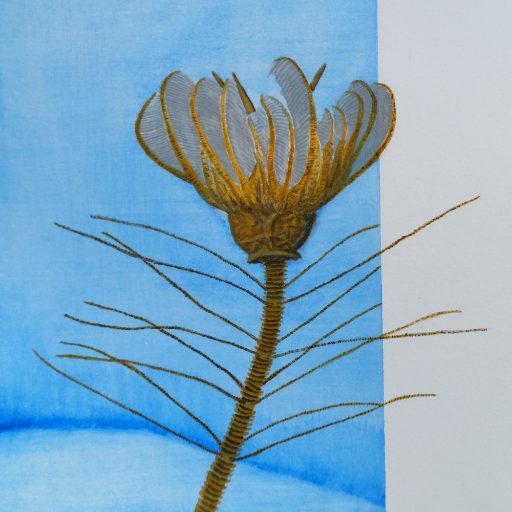
Cystoids are extinct echinoderms related to starfish and sand dollars. This is Pleurocystites squamous from the Ordovician Bobcaygeon formation near Brechin, Ontario. It's about 3.5 cm long including the stem. There are 3 rhombs visible that are part of the respiratory system.

 @captainfossil.bsky.social
(The original image at the top of this post is from McDonald and Scott 2023, "The Pleistocene Fauna of Big Bone Lick, Boone County, Kentucky: A Rich History and Unanswered Questions", available as part of this volume.) #FossilFriday 🧪
@captainfossil.bsky.socialFor #FossilFriday: holotype of the extinct Pleistocene bison species Bison antiquus, one of millions of specimens housed in the collections of the Academy of Natural Sciences of Drexel University - the oldest natural history museum in the US, now slated for permanent closure on 30 September. 🧪
 @clarkeocrinus.bsky.social
A delicate crane fly (Pronophlebia rediviva) from the Eocene Green River formation near Bonanza, Utah. This specimen is about 1 cm long. If you look closely, you can even see the eyes.
 @clarkeocrinus.bsky.social
I love fossils with regeneration. It shows how the animal lived and survived.
 @cisneros.bsky.social
Apenas um dente. Anisopleurodontis pricei (cinsegue falar?) foi um parente distante dos tubarões e das quimeras de hoje. Viveu há uns 280 milhões de anos atrás no Maranhão e no Piauí.
#FossilFriday

 @ncse.bsky.social
Ouch! A Cretaceous ulcer! www.discovermagazine.com/swelling-on-...
#FossilFriday #paleosky
 @dolphinseeker.mstdn.social.ap.brid.gy
'Peculiar' new species of Jurassic squid found in Wyoming https://phys.org/news/2026-09-peculiar-species-jurassic-squid-wyoming.html 🦑 #MarineLife #MarineBiology #FossilFriday #Prehistoric #Evolution #Science
 @paleosol.bsky.social
Have a gander at this here paleosol for #FossilFriday, only 360 million years young! (Hampshire Fm. of WV)
1) beautiful fossil root trace (rhizolith) plugged with calcite.
2) pedogenic carbonate nodule with nice septarian cracks.
These billets have been sent out for thin sections. Stay tuned!
⚒️🧪


 @cenofreak88.bsky.social
#fossilfriday an ice age bighorn sheep skull. On display at the Natural History Museum of Utah, Salt Lake City.
#naturalhistorymuseumofutah #prehistoricutah #iceage #bighornsheep

 @dr-crocogator.bsky.social
Happy #FossilFriday! The big #Minnesota State Fair has wrapped and alongside the #dinosaur exhibit & outreach, we did 6 TV interviews plus quotes for a magazine and a newspaper. It’s been great exposure for the Science Museum of Minnesota and a fun opportunity for folks to learn about ancient life!


 @anajusagasti.bsky.social
Very happy to have been part of this collaboration and give a #FossilFriday perspective to the amazing work led by Xilan Yang and Tom Beeckman.
 @xrciseguy.bsky.social
#FossilFriday: Stegosaurus, on display at the Royal Belgian Institute of Natural Sciences in Brussels.

 @prehistoricmuseum.bsky.social
It’s Fieldwork Friday!
Today we are highlighting our recent 2026 fieldwork near Ferron Mountain.
Here are some shots of our amazing team with some amazing fossils!
#fieldworkfriday #fossilfriday #volunteers #fossils #paleontology
 @deinocurious.bsky.social
This new year marks the start of a new chapter in my academic life (and life in general!) - I'll finally start formally studying dinosaurs, some of the most successful and wonderful animals to have ever walked the Earth.
I have to say, I am excited :) #Paleosky #FossilFriday
 @deinocurious.bsky.social
The Museo Carmen Funes (MCF), located in the town of Plaza Huincul, Argentina, is one of those places that as a child were so far from reach. Getting there and seeing the main exhibition hall by myself really felt like a personal achievement. Hope to show more from the exhibits soon #FossilFriday
 @deinocurious.bsky.social
#FossilFriday
Today is the Jewish New Year's Eve, a time to look back at the last year and to wish and strive for better. My journey to South America is definitely one of the highlights, including this moment: observing the fossil vertebrae of Argentinosaurus, likely the largest dinosaur known ->


 @thepalass.bsky.social
Charnia & other late Ediacaran macrofossils preserved in turbiditic deposits of the Indreelva Member (Finnmark, Norway) onlinelibrary.wiley.com/doi/10.1111/... #FossilFriday

 @denverfowler.bsky.social
This is a sacrum (vertebrae that fuse over the hips), from a parrot-mimic raptor dinosaur (caenagnathid, oviraptorosaur). These feathered raptors have quite fragile bones and are consequently quite rare.
