Palaeoartist, palaeontologist, author, documentary consultant and creature designer. Affiliated with the University of Portsmouth, UK; views and opinions are my own.
More about me at markwitton.co.uk.
Support my work at www.patreon.com/markwitton

@markwitton.bsky.social
Palaeoartist, palaeontologist, author, documentary consultant and creature designer. Affiliated with the University of Portsmouth, UK; views and opinions are my own.
More about me at markwitton.co.uk.
Support my work at www.patreon.com/markwitton
@markwitton.bsky.socialI may have misspoke with "regular". There's definitely scope and interest for this to happen again, though (and if so, certainly not for 2-3 years at least).
@markwitton.bsky.socialThanks to the conference organisers - Nigel Larkin, Emma Nicholls, Dean Lomax and Mark Evans - for a great week of talks and events. Should this be a regular meeting? Yep.
@markwitton.bsky.socialWent to Crocodiles of the World today to conclude the Oxford Marine Reptile Conference. Much time spent time with amazing, hyper-charismatic reptiles and made loads of cool observations, including the teeth-sheathing gingiva of a Komodo dragon, high walking Nile crocs and nippy Galapagos tortoises.


 @markwitton.bsky.social
As you've indicated, it's really locomotion + the need to come onto land that's the issue here, and theropods seem steadfast in never going quadrupedal. That's going to be an issue if they want to start wriggling out of the sea at any sort of large size.
@markwitton.bsky.socialThey're gigantic. The Mesozoic was filled with horsetails that could hide good-sized dinosaurs.
@markwitton.bsky.socialEither way, I guess the maximum size of a Thalassoraptor-like animal is something we can have fun with, and the exact figure won't alter the main point (that their maximum size would be way below that of other marine tetrapods).
@markwitton.bsky.socialLikewise, with turtles being soft-shellers, can we rule out that giant species developed live birth? I don't know what the consensus on this is, but rhere might be aspects of their limb anatomy that tell whether Archelon et al. were still crawling onto land.
@markwitton.bsky.socialI could be wrong on this, but pseudosuchians were ancestrally laying soft shelled eggs, so they could evolve viviparity until hard shells became the norm. To my knowledge, we don't yet know when that happened. Could be after the thalattosuchian split?
@markwitton.bsky.socialThe question on maximum size is an interesting one. I went with modern size limits of land-based marine tetrapod reproduction (pinnipeds) for Thalassoraptor because I'm unsure if we can rule out that big marine crocs and turtles were viviparous.
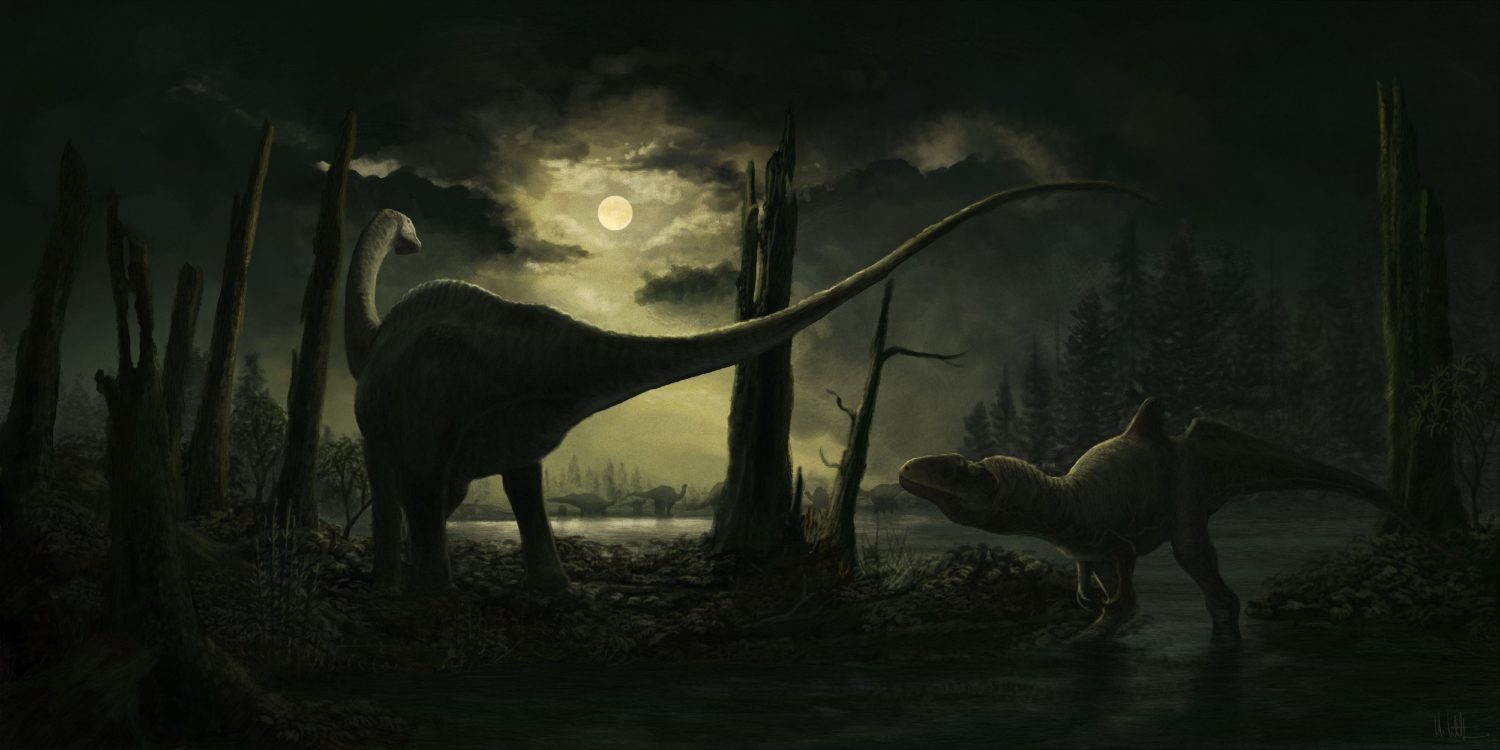
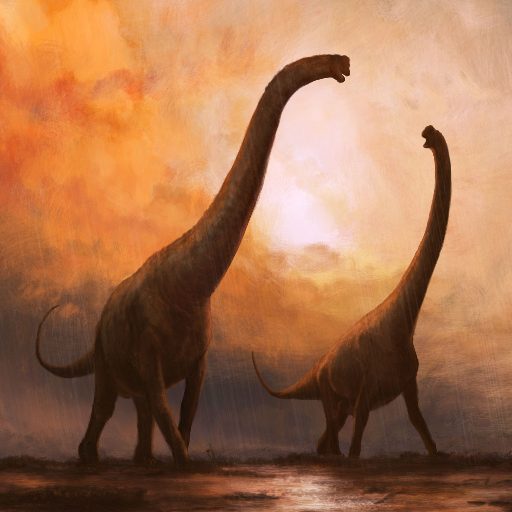
@markwitton.bsky.socialI haven't posted anything for a while, so here's some new #paleoart for #FossilFriday: Cetiosaurus in a Middle Jurassic landscape. I've had to compose and execute this in just two days, so hopefully it looks OK! (All data for the plant recons comes from @palaeojules.bsky.social.)
#dinosaur #sciart
 @markwitton.bsky.social
Absolutely no problems with melanin-rich dinosaurs. Strongly melanised dorsums are known from a couple of dinosaurs now, and there's no reason to think some species/individuals couldn't push that even further.
@markwitton.bsky.socialWife @gizz47.bsky.social is currently running a 10km race to raise money for Bhutanese tigers. There's still time to donate some money towards the cause if you have some spare change. Would be great to see her make the £200 target!
@markwitton.bsky.socialPlease finish this, it already looks great! But don't use Dimorphodon as the insect chaser, it likely didn't have the flight agility to hawk insects. Campylognathoides would be a better bet.
@markwitton.bsky.socialNew #paleoart for #FossilFriday: Baryonyx walkeri portrait factoring new epidermal correlate data gathered for an ongoing project. "Yes" to lips, "no" to a cornified sheath on the nasal crest, "yes" to a boss and scale above the eyes. More details at my Patreon: www.patreon.com/markwitton
 @markwitton.bsky.social
Hey, look: the cover of my next book has been revealed. Looks like it'll be out next March.
Details: press.princeton.edu/books/hardco...
 @markwitton.bsky.social
Thanks, it's strange to me that I remember drawing them after all this time. Those perpendicular creases are where the paper was folded to fit into my school blazer pocket, as I was drawing them at school between lessons.
@markwitton.bsky.socialAnd just for fun, because I seem to have them saved in the same directory, here are Deinonychus predation scenes that I drew when I was 13-14 years old. They are preying on iguanodonts because Cretaceous sauropods weren't on the radar when I was small.

 @markwitton.bsky.social
For #FossilFriday, here's some 2019 #paleoart of Deinonychus subduing a juvenile Sauroposeidon using the Raptor Prey Restraint (RPR) model of dromaeosaur predation: grabbing prey with taloned feet, pinning it down with its body weight, and then eating it alive. Just like modern raptors, then.
 @markwitton.bsky.social
This #paleoart of #Pteranodon standing on a wave-crashed rock seems to be a favourite for some, judging by steady print sales over the last 10 years. I recall it coming together quickly, probably because I did it for my own enjoyment and fully engaged with my impulses towards romantic art.
 @markwitton.bsky.social
Over at #Patreon, I've been discussing my latest #specevo #dinosaur piece for my upcoming book. Meet Thalassoraptor maximus: non-bird dinosaurs have finally made it into the oceans! About time, guys, sheesh.
Lots more detail at www.patreon.com/markwitton/p....