Grilled Cheese

ExploreLog inSign up

Pat Savage

@patrickesavage.bsky.social

816 Following2.7k Followers

Author: Comparative Musicology (academic.oup.com/book/62353; open access)
Director: @compmusiclab.bsky.social
Host/PI @manyvoices.bsky.social
Rutherford Discovery Fellow @U Auckland
Assoc. Prof. @Keio U
Music, evolution, diversity
He/him
Tangata tiriti

PostsRepliesMedia
@patrickesavage.bsky.socialOct 10, 2026, 11:46 PM

Hard to say. It’s fairly short, but very bad. But kind of fun to hate-read.
@patrickesavage.bsky.socialOct 10, 2026, 2:42 PM

Link plus some commentary here:

bsky.app/profile/patr...

@patrickesavage.bsky.socialOct 10, 2026, 11:52 AM

I love Sona Jobarteh!

@lastpositivist.bsky.socialOct 10, 2026, 9:33 AMReposted by @patrickesavage.bsky.social

Ok I read this and I know I am sort of in the Well He Would Say That Wouldn't He category, but I agree with Pat Savage here that this report was *remarkably* bad. Like actually to the point that at times its hard to work out what the complaint is or how one is meant to infer anything from it.

@patrickesavage.bsky.socialOct 10, 2026, 8:54 AM

I was really looking forward to this when I visited Leipzig last year. But I was so jet lagged, I had to take a nap around 3pm and when I woke up it was 11pm and the festival was over 😱

@patrickesavage.bsky.socialOct 9, 2026, 7:40 PM

Another enraging thing about this "report" is it claims to represent all of music studies (including ethnomusicology/comparative musicology, which has been devoted to the study of non-Western music for over 140 years), but it's data exclude ethno and focus almost exclusively on music theory

Report on Music Studies Kit Fine in collaboration with Simon Morrison Music Studies is a broad field, encompassing musicology, music theory, ethnomusicology, performance and composition. There is also a growing empirical division: cognition, which brings Music Studies into contact with psychology and neuroscience. For the purposes of the present report, we have largely focused on the first three areas; although there are significant differences between them, we have concluded that there are enough similarities in the issues to which they give rise to justify a common treatment. It should be emphasized, however, that we have not been as thorough or systematic in our review as in the case of other disciplines.Figure 1.3 Simplified adaptation of Adlerʼs (1885/1981) classification of the field of musicology, including sub-fields such as historical musicology and comparative musicology. 

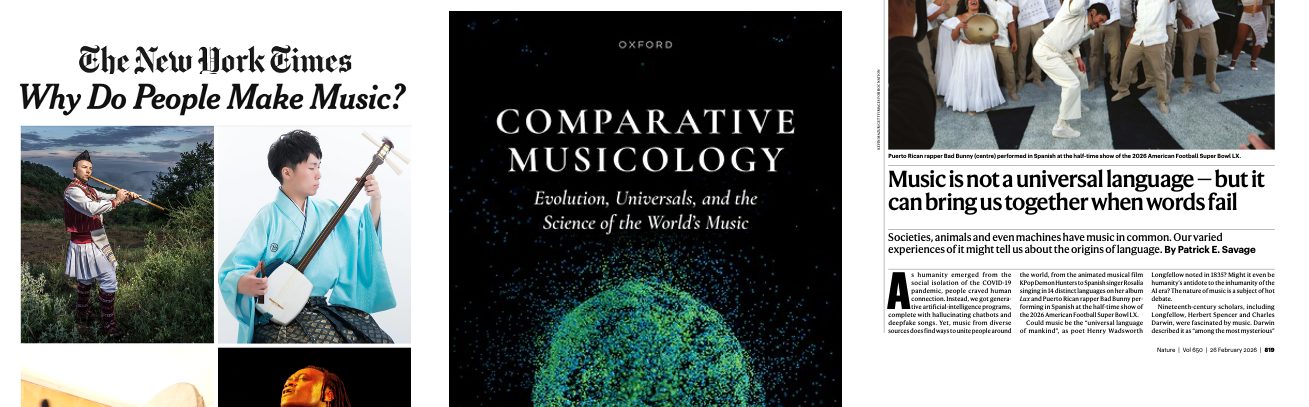
Source: “Comparative musicology: Evolution, universals and the science of the world’s music” (Savage, 2026, Oxford University Press)
@loadofbunk.bsky.socialOct 9, 2026, 2:25 PMReposted by @patrickesavage.bsky.social

Damn. Music studies scholars are arguing for controversial theses and others are debating them collegially? That's crazy. I don't know how the humanities and humanistic social sciences can survive after this has been brought to light.

Jason Yust (details in appendix D.5). The “Featured Essay” in Volume 68, Issue 1 of the Journal of Music Theory (2024) is “Tonality and Racism” by Jason Yust (BU, Music Theory). In this paper, he advocates “dropping the term [tonality] from our theoretical lexicon” on the grounds that the concept is “problematic—racist, colonialist, and a hindrance to scholarly progress.” This is, to put it mildly, a highly controversial thesis. Yet of the nine responses published in the same issue of the journal, only two rejected Yust’s proposal; four endorsed retiring the term, and the remaining three accepted much of his critique while stopping short of endorsing retirement
@noamchompers.bsky.socialOct 9, 2026, 6:50 PMReposted by @patrickesavage.bsky.social

lotta people have been asking

kit fine vs music studies who would win meme
@mattweiner19.bsky.socialOct 9, 2026, 3:08 AMReposted by @patrickesavage.bsky.social

I'm gobsmacked at this passage. There is no "data" on cancel culture, it is seven anecdotes, and those anecdotes do not "show" this! You need an argument!

What are we to make of the data? The data on the presence of a cancel culture show that there has been an undue preoccupation with social justice and other social issues.
@patrickesavage.bsky.socialOct 9, 2026, 4:40 AM

Yes

@patrickesavage.bsky.socialOct 9, 2026, 4:37 AM

Yup! Get those woke biographies of Beethoven out of here!

@patrickesavage.bsky.socialOct 8, 2026, 3:41 PM

Also funny that they then go on to base most (all?) of their data and analyses on just one of these sub-fields (music theory) without any justification or explanation.

@patrickesavage.bsky.socialOct 8, 2026, 2:48 PM

@patrickesavage.bsky.socialOct 8, 2026, 2:45 PM

It's weird that only Kit Fine is an author on the overall Vanderbilt report, while this sub-report is listed as being written by "Kit Fine in collaboration with Simon Morrison". One of many weird things about this report and the whole Vanderbilt report...

@patrickesavage.bsky.socialOct 8, 2026, 2:43 PM

Yes, it's so deeply flawed in so many different ways...

@ndrew.bsky.socialOct 8, 2026, 1:16 PMReposted by @patrickesavage.bsky.social

they did the thing

an october 11 2025 post from me reading: every single tech idea is like “soon our robots will be capable of playing catch with your kid, freeing you up to spend more time working on your employers’ spreadsheets”
V🎃👻🧙‍♀️ Vio the VVitch 🧙‍♀️👻🎃@viothevvitch.myatproto.socialOct 8, 2026, 11:30 AM

this is so fucking sad

Alvin Sng 0 @alvinsng My wife: Can you read our baby a book?
Follow
Me: Icanjust play an audiobook from my phone.
My wife: But then it won't be in your voic e.
Me:| can train a voice model.
Parenting hits different when you workin Al.
8:30 AM .07 Oct 26 . 816K Views
Q713
t2 594
542
356
253
@patrickesavage.bsky.socialOct 8, 2026, 2:23 PM

Yup - or in the trash! (My reply was intended for @chromeowtic.bsky.social though)

@patrickesavage.bsky.socialOct 8, 2026, 2:20 PM

Saved you the trouble and psychic damage:
bsky.app/profile/patr...

@patrickesavage.bsky.socialOct 8, 2026, 7:45 AMReposted by @patrickesavage.bsky.social

Correct. Increase in the study of any music that is not "Baroque, eighteenth- and nineteenth-century common-practice period, and modernist European (Western) canon" represents, by their methods, a decrease in scholarly standards. It's so bad, it's beyond parody.

The main trend we detected is the shift from what one might call the central areas of music  scholarship to the more peripheral areas. Of course, “center” and “periphery” are not well-defined  terms, though convention since the nineteenth century has tended to push vernacular and liturgical genres of music to the outside of the high art secular traditions. Jazz only began to be incorporated into studies of musical modernism in the second half of the twentieth century, even though jazz was perceived outside of the Americas as modernist music. But, in general, “center” focuses on the repertoire within the Baroque, eighteenth- and nineteenth-century common-practice period, and modernist European (Western) canon and uses the time-tested tools of music theory (formalfunctional analysis involving Riemannian harmonic labels; Schenkerian voice-leading graphs, theories of mode, rules of counterpoint, schema theory, and neo-Riemannian modeling methods) to understand the harmonic, melodic, and rhythmic syntax of the works within that tradition.
@patrickesavage.bsky.socialOct 8, 2026, 7:45 AM

How I wish that were the worst of their methodological crimes!

Older posts
Terms of UsePrivacy PolicyCommunity StandardsHelpGet the app

Grilled Cheese is a product of Village Compute

Version devBuilt at: 2026-10-11 02:37:10 EDT