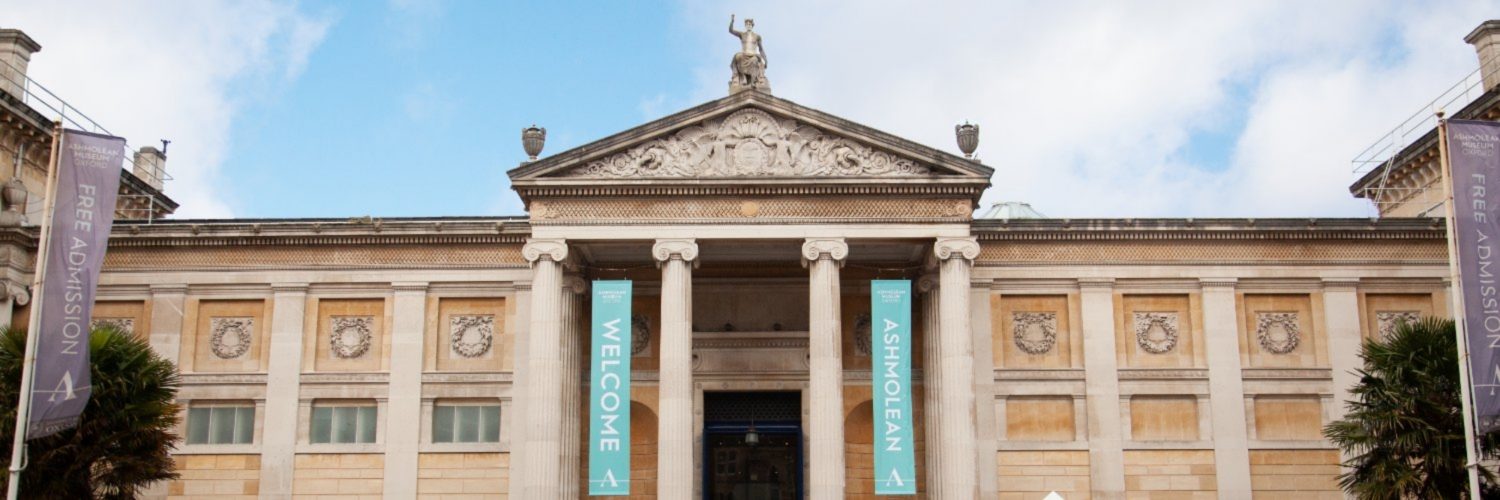
🖼 🏺 World famous collections, from Egyptian mummies to contemporary art
🕙 Open every day 10am–5pm 🏛 linktr.ee/ashmoleanmuseum


@ashmoleanmuseum.bsky.social
🖼 🏺 World famous collections, from Egyptian mummies to contemporary art
🕙 Open every day 10am–5pm 🏛 linktr.ee/ashmoleanmuseum
@ashmoleanmuseum.bsky.socialThe brooch was designed in a pre-Roman ‘Celtic Art’ style, reminiscent of a time before the Romans occupied Britain in 43 CE. See it on display in Gallery 13, Level G. Dragonesque brooch, c. 100BCE – 200CE. Copper alloy, 5.6cm. AN1927.4616
@ashmoleanmuseum.bsky.socialThey would have been used as clothes fasteners, but they were also highly decorated. This brooch was probably enamelled, so it would have been a colourful addition to any wardrobe.
@ashmoleanmuseum.bsky.socialThis Late Iron Age cast dragonesque brooch features a complicated design with schematic animal heads at either end and a yin-yang in the centre. Dragonesque brooches were made from around 75–175 CE in Roman Britain.
 @ashmoleanmuseum.bsky.social
This particular vase also features an inscription in German which translates to ‘Honour the women! They spin and weave heavenly roses into earthly life’. 🌹 Two Biedermeier beakers, Vienna, c.1820–1830. WA1939.46 and WA1939.45
@ashmoleanmuseum.bsky.socialIn 1816 Anton Kothgasser set up his own studio in Vienna for decorating glass and became known for producing beakers like the one of the left here decorated with flowers.
@ashmoleanmuseum.bsky.socialThese beautiful beakers were made in Vienna during the 19th century. The technique of decorating glass in transparent enamels was developed in the early 19th century.
 @ashmoleanmuseum.bsky.social
🐚 Venus, Sandro Botticelli & workshop, c. 1490, tempera on canvas, Staatliche Museen zu Berlin, Gemäldegalerie/ photo: Jörg P. Anders; Public Domain Mark 1.0
@ashmoleanmuseum.bsky.social🐚 💫 Aphrodite: The Making of a Goddess is NOW OPEN
★ ★ ★ ★ The Times
★ ★ ★ ★ The Telegraph
Join us to uncover the making of a goddess whose legacy still shapes our ideas of love and beauty today.
🎟️ Book your tickets: ashmolean.org/exhibition/a...
🏛️Ashmolean Members go for free.


 @ashmoleanmuseum.bsky.social
The pincered decoration of lozenges on the body is known as 'nipt diamond waies', a type of decoration with Venetian origins, which is not surprising as workers from Murano were employed in Ravenscroft's glass-house at the Savoy, London. See it on display in Gallery 48 on Level 2. 💜 WA1957.24.2.1
@ashmoleanmuseum.bsky.socialGeorge Ravenscroft (1618-81), a glass merchant, was the first to obtain a patent to produce lead-glass in England from 1674.
@ashmoleanmuseum.bsky.socialThis beautiful amethyst-tinted serving bottle is made from a type of glass developed during the 1670s that contained a high percentage of lead. This so-called ‘lead-glass’ or ‘crystal’ was much heavier, less fragile and more brilliant than that produced previously in either England or Europe.
 @ashmoleanmuseum.bsky.social
Here, Ruskin has captured the apse of Pisa's cathedral. In 1873, he said of this building that ‘no architecture on this grand scale, so delicately skilful in execution, or so daintily disposed in proportion, exists elsewhere in the world’. 🖌️ WA.RS.REF.076
@ashmoleanmuseum.bsky.socialJohn Ruskin had a lifelong interest in architecture. Some of his first articles were published in The Architectural Magazine, 1837–8, and his book The Stones of Venice (1851–3) was arguably his most influential work.
 @ashmoleanmuseum.bsky.social
Amongst them was this remnant of a wheel hub. See it on display in Gallery 24, Level G. Hub and spokes of chariot wheel, c. 1539–1075 BCE. Elm and tamarisk wood, with remains of plaster and rawhide binding, 29 cm length. AN1923.663.2
@ashmoleanmuseum.bsky.socialMuch of our knowledge of these vehicles is derived from the six found in the tomb of Tutankhamun. Seven years before Lord Carnarvon and Howard Carter made their most celebrated discovery, they had investigated the tomb of king Amenhotep III, where they found pieces of a royal chariot.
@ashmoleanmuseum.bsky.socialThis hub and spokes of a chariot wheel is over 3,000 years old! Horse-drawn chariots came to symbolise the might of the pharaoh. Actual chariots were placed in the tombs of kings and high-ranking courtiers.
 @ashmoleanmuseum.bsky.social
🦇 Ojime bead in the form of a bat, Japan, late 19th century, EA1956.3749 🐝 Tetradrachm coin with a bee, Turkey, silver, HCR5273 🐇 Tile with a rabbit or hare, Seville, 16th century, WA1951.60 🐻 Black bear cub in snow, Mori Shūhō (1738 - 1813), ink and colour on silk, EA1964.95.f
@ashmoleanmuseum.bsky.social🦑 Ojime in the form of an octopus, Japan, late 19th century, EA1956.3481 🐶 Dog beneath bamboo, Qizong Zhang (c. 1931), ink and colour on silk, EA1967.13 🦁 Gold-glass fragment, medallion with the head of a leopard with open jaws, Catacombs of Rome, 200-400 CE, gold and glass, AN2007.29
@ashmoleanmuseum.bsky.socialHappy #WorldAnimalDay! Do you have a favourite in the Ashmolean?
World Animal Day exists to celebrate animals but also to raise their status and improve welfare standards around the globe. The 4th of October is the feast day of St Francis of Assisi, the patron saint of animals.
@ashmoleanmuseum.bsky.social🖌️ Venus, Sandro Botticelli & workshop, c. 1490, tempera on canvas, Staatliche Museen zu Berlin, Gemäldegalerie/ photo: Jörg P. Anders; Public Domain Mark 1.0