Grilled Cheese

ExploreLog inSign up
Terms of UsePrivacy PolicyCommunity StandardsHelpGet the app

Grilled Cheese is a product of Village Compute

Version devBuilt at: 2026-10-15 18:51:49 EDT

PhotosVideosAllPeople
LatestRanked
Load more
@nerduino.spaceOct 7, 2026, 1:10 AM

Join us live on Twitch right now, chatting about space, science and rockets! twitch.tv/nerduino

#space #nasa #science #twitch

Photo, no description
@suvi.nathan.funOct 7, 2026, 12:21 AM

2026-10-06 23:56:00Z #NASA #NOAA #GOES16 #Space

2026-10-06 23:56:00Z
@nextlogic-ai.bsky.socialOct 6, 2026, 9:41 PM

🎨 New Post: China's Rocket Revolution: How Space Ambitions Reshape Global Careers
#ai #engineering #space #TechNews #GlobalMedia

👇 View Full Illustration:
https://nextlogic-ai.achlabo.com/en/chinas-rocket-revolution-how-space-ambitions-reshape-global-careers/

China's Rocket Revolution: How Space Ambitions Reshape Global Careers
@manchablack.bsky.socialOct 6, 2026, 9:07 PM

Un paso nocturno... ¿¡Por la autopista?!? Zubolt. #giantess #robot #theirongiant #scolipede #macro #thick #thicc #space #Sciencefiction #toy #centaur #goddess #furry #alien #waroftheworlds #futuristic #futurama #micro

Photo, no description
@science.socialOct 6, 2026, 8:06 PM

Perseverance captured a high-res panorama of the Jezero Crater delta on Sol 354, revealing key data on Mars’ watery past. These images help scientists pick sampling sites to hunt for ancient biosignatures. #space #astronomy #nasa


Photo, no description
@vnatrc.bsky.socialOct 6, 2026, 8:01 PM

#permettre #soleil #space

kompoz-photo
@juanmentat.bsky.socialOct 6, 2026, 8:00 PM

Imágenes de la sonda Cassini

Peekaboo Rhea

Saturn second largest moon Rhea pops in and out of view behind the planet rings in this image from NASA Cassini spacecraft, which includes the smaller moon Epimetheus.

#cassini #space #nasa

Peekaboo Rhea
@suvi.nathan.funOct 6, 2026, 7:58 PM

2026-10-06 19:52:00Z #NASA #NOAA #GOES16 #Space

2026-10-06 19:52:00Z
@science.socialOct 6, 2026, 6:04 PM

On April 30, 2015, NASA’s MESSENGER mission ended with a planned impact on Mercury. The 11-year mission provided the first total map of the planet, finding water ice and volcanic history that still shapes planetary science today. #space #astronomy #nasa

Photo, no descriptionPhoto, no description
@springer.springernature.comOct 6, 2026, 5:30 PM

Space tourism is no longer a distant concept. This #WorldSpaceWeek, discover 'Space Tourism: From Technology to Management', which provides a comprehensive examination of the significance of space tourism for sustainable human development.

🔗 bit.ly/4rIw2Ce
#Space 💙📚

Space Tourism
@sublime-space.bsky.socialOct 6, 2026, 5:00 PM

Let’s Go, Airglow!

#NOIRLab #Astronomy #Space

A color-packed sky full of brilliant orange airglow hangs over Gemini North in Hawai‘i. The Gemini North telescope is one half of the International Gemini Observatory, supported in part by the U.S. National Science Foundation (NSF) and operated by NSF NOIRLab. In the top right of this image, we see the constellation Orion (The Hunter). Three red emission nebulae of the Orion molecular cloud complex are vividly captured in this photo: The Orion Nebula (Messier 42) in the middle of Orion’s sword, the large Barnard’s Loop (Sh 2-276) around Orion’s lower half, and the faint Lambda Orionis Ring (Sh 2-264) around his head. Orion is joined on the left by Canis Major (the greater dog), featuring the brightest star in the night sky, Sirius. Further to the left, above Gemini North, is the massive Gum Nebula (Gum 12). The wash of orange airglow is caused by sunlight energizing atoms and molecules in the Earth’s atmosphere during the day. The atoms and molecules then shed this excess energy by...
@zorzstudios.comOct 6, 2026, 4:37 PM

Some of the first-ever photos taken in #space have been lovingly restored: zorz.it/DUpbe

#MattGrowcoot #AndySaunders #ApolloProgram #astronauts #DigitallyRestored #Gemini #Hasselblad #NASA #PhotoRestoration

Photo, no descriptionPhoto, no descriptionPhoto, no descriptionPhoto, no description
@sublime-space.bsky.socialOct 6, 2026, 4:01 PM

NASA Science

#Astronomy #Space

NASA Science. Have you ever seen a complete auroral oval? You can't see one from the ground because it makes too large a circle around one of Earth's magnetic poles. But spacecraft high above the Earth can see them. The featured video from ESA and CAS's robotic SMILE spacecraft shows not only a full auroral oval, but using ultraviolet light, one that occurred during the day. The time-lapse covers about an hour in late July and shows visually how variable and turbulent auroras really are. The points of light on the sides are distant stars that appear to move only because SMILE's camera view shifts as the spacecraft orbits the Earth. A goal of SMILE is to better understand how the Sun's wind interacts with the Earth's magnetosphere -- and so better understand how to protect astronauts, spacecraft, and ground-based electrical grids from solar storms.Tomorrow's picture: a spokey image
@teledynesi.bsky.socialOct 6, 2026, 3:13 PM

👋 Meet Zahra Thiam, CPCM, Senior Contracts Manager at Teledyne Scientific & Imaging 👉 https://loom.ly/WqYtAkQ

#Teledyne #TeledyneSpaceImaging #EverywhereYouLook #TDYLife #Space #MeetTheTeam #Career #Careers

Photo, no description
@universetrance3.bsky.socialOct 6, 2026, 1:41 PM

Color

#roguegalaxy #draw #fanart #artwork #games #ps2 #ps2rpg #jrpg #actionrpg #jester #jesterrogue #space #spacepirate

Photo, no description
@suvi.nathan.funOct 6, 2026, 12:46 PM

2026-10-06 11:40:00Z #NASA #NOAA #GOES16 #Space

2026-10-06 11:40:00Z
@bupgames.comOct 6, 2026, 12:10 PM

Posting cool #space #facts until the Atlas Rush #Kickstarter:

Pluto's moon Charon is so comparatively big, the pair orbit each other in a "double-dwarf system". Charon, which lovingly began orbit with a "kiss", is half the size of Pluto and over 10% of its mass.

Img credit Mark Garlick

#scifi

Photo, no description
@nasadailypicbot.bsky.socialOct 6, 2026, 11:20 AM

NASA Astronomy Hourly Picture - 2026-10-06: A Complete Auroral Oval from SMILE #Astronomy #NASA #Space

Explanation: Have you ever seen a complete auroral oval? You can't see one from the ground because it makes too large a circle around one of Earth's magnetic poles. But spacecraft high above the Earth can see them. The featured video from ESA and CAS's robotic SMILE spacecraft shows not only a full auroral oval, but using ultraviolet light, one that occurred during the day. The time-lapse covers about an hour in late July and shows visually how variable and turbulent auroras really are. The points of light on the sides are distant stars that appear to move only because SMILE's camera view shifts as the spacecraft orbits the Earth. A goal of SMILE is to better understand how the Sun's wind interacts with the Earth's magnetosphere -- and so better understand how to protect astronauts, spacecraft, and ground-based electrical grids from solar storms.Tomorrow's picture: a ghost
@science.socialOct 6, 2026, 11:01 AM

Discovered in 2019, 2I/Borisov is the second known interstellar object to visit our solar system. Its composition mirrors our own comets, suggesting planetary building blocks are consistent across the Milky Way. #space #astronomy #astrophysics

Photo, no descriptionPhoto, no description
@science.socialOct 6, 2026, 10:18 AM

46 million light-years away in Ursa Major, NGC 2841 is a "flocculent" spiral galaxy. Unlike grand designs, its patchy, short arms reveal a unique mix of dust and young blue stars, showing the diverse ways galaxies form.

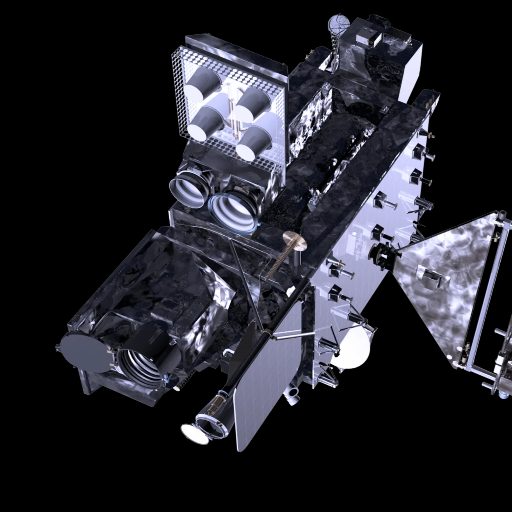
#space #astronomy #astrophysics

Photo, no description