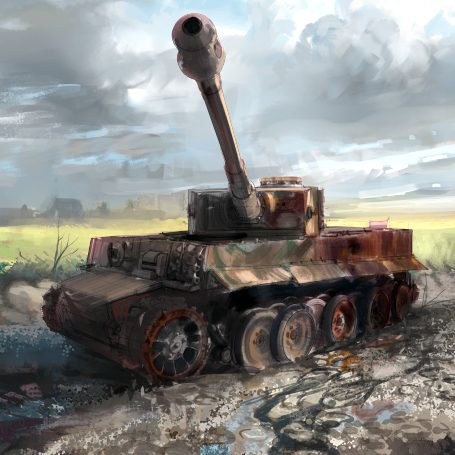
Operation Typhoon began #OTD in 1941, marking the start of the Battle of Moscow. The plan called for massive pincers to grip the city from the north and south, but only a tiny German force even made it close to Moscow before the tide of war turned. #tanks#history#WW2#WWII
PQ-1, the first regular Arctic convoy, set out for the USSR #OTD in 1941. This tank brought a handful of Matilda III and Valentine II tanks that arrived just in time to take part in the finishing stages of the Battle of Moscow. #tanks#history#WW2#WWII
Calculations made #OTD in 1943 showed that while the T-43 could be modernized to meet rising requirements, its weight would surpass 35 tons. A decision was made to drop the project and focus on a new tank, which later became the T-44. #tanks#history#WW2#WWII
Canada had a choice of several tanks to build when they decided to form an armoured division. #OTD in 1939 they ordered blueprints for the Infantry Tank Mk.III from Vickers. This was the option they went with in the end, building 1420 tanks in Montreal. #tanks#history#WW2#WWII
#OTD in 1942 a proposal was made to use leftover T-60 tank hulls to build armoured sleds that a T-34 or a KV tank could tow into battle as a sort of pseudo-APC. Many experiments were performed, but no such vehicle was ever put into production. #tanks#history#WW2#WWII
The second pilot Covenanter tank was delivered for trials #OTD in 1940. The compact cooling system turned out to be ineffective, causing a lot of problems during usage. There were attempts to correct this, but the Covenanter never became battleworthy. #tanks#history#WW2#WWII
Swamp mobility trials of the Czechoslovakian LT vz. 35 tank were held in the USSR #OTD in 1938. Thanks to a better suspension than the T-26, it moved much more confidently in difficult terrain. #tanks#history
The Valentine XI was the last type of Valentine tank, featuring a 75 mm gun instead of the 57 mm 6-pounder. #OTD in 1943 Elswick Works delivered their 100th and last Valentine XI tank. #tanks#history#WW2#WWII
Tankograd was created not just by relocating existing factories, but by reallocating new ones to tank production. #OTD in 1942 the first T-34 tanks were completed at UZTM in Sverdlovsk. These factories were also used as a source of chassis for the SU-85 #tanks#history#WW2#WWII
A report on tank reliability in the Soviet-Japanese War was published #OTD in 1945. Similar % of T-34-85 and M4A2 tanks broke down during the operation (8.3% vs 8.2%). The tanks were similarly likely to suffer from engine failure (~55% of the total). #tanks#history#WW2#WWII
The trials program for penetration testing of the Ferdinand tank destroyer was completed #OTD in 1943. Tests showed that despite its thick armour, it could be defeated by existing guns including the 122 mm D-25 and 152 mm ML-20. #tanks#history#WW2#WWII
#OTD in 1942 the British offered the USSR additional shipments of anti-tank weapons: PIATs and Boys rifles. The offer was declined. The Red Army did not consider these weapons effective and they saw almost no front line service. #tanks#guns#history#WW2#WWII
Trials of a SU-31 SPAAG based on T-60 components began #OTD in 1942. The trials showed that the SPAAG had identical mobility to the light tank and that the parallel engine layout showed a lot of promise. This solution migrated to the SU-12 (SU-76). #tanks#history#WW2#WWII
I remember playing this game at Dave and Busters a long time ago. Definitely one those arcade games to pass the time if you are waiting for another one to be open to play. #retrogaming#tanks#arcadegame#youtube
The first 10 Czechoslovakian AH-IV-R (R-1) tankettes built for Romania was completed #OTD in 1937. Romania wanted to build these vehicles locally in addition to purchasing Czechoslovakian ones, but only one was ever completed. #tanks#history
The first wartime contract for Char B1 tanks was signed #OTD in 1939. The army wanted 400 more heavy tanks but only 34 from this contract were finished before France surrendered. #tanks#history#WW2#WWII