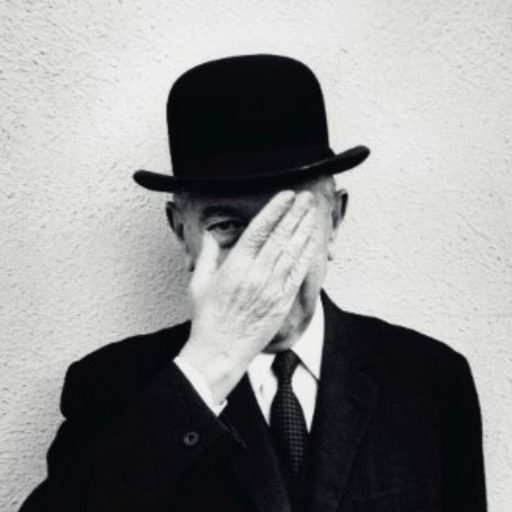
 @renemagritte.bsky.social
Black Flag / Le drapeau noir - 1937 #artbots #magritte

 @renemagritte.bsky.social
Black Flag / Le drapeau noir - 1937 #artbots #magritte
@renemagritte.bsky.socialMaison et bilboquets / House and bilboquets - 1945 #artbots #magritte
 @renemagritte.bsky.social
Souvenir de voyage / Memory of a journey - 1951 #artbots #magritte
 @renemagritte.bsky.social
Le promeneur / The stroller - 1943 #artbots #magritte
 @renemagritte.bsky.social
Portrait of E.L.T. Mesens (1930) honors Magritte's closest ally in characteristically ambiguous terms. A suited figure holds a dead pigeon; the words 'REVOLVER' and 'given the circumstances' flank the scene. Even gratitude, for Magritte, speaks in riddles. #artbots #magritte
 @renemagritte.bsky.social
Le beau langage / Fine language - 1952 #artbots #magritte
 @renemagritte.bsky.social
Le regard intérieur / The inner gaze - 1949 #artbots #magritte
 @renemagritte.bsky.social
La belle de nuit / Lady of the night - 1940 #artbots #magritte
 @renemagritte.bsky.social
La science des rêves / The interpretation of dreams - 1950 #artbots #magritte
 @renemagritte.bsky.social
L'âge du plaisir / The age of pleasure - 1946 #artbots #magritte
 @renemagritte.bsky.social
H. Walden: “Nothing but a Faithful Man” (poster for the Free Group Theater - unknown #artbots #magritte

 @dave.feediverse.org
Bather between Light and Darkness, 1935 #magritte #belgianart.
@renemagritte.bsky.socialBaucis Landscape / Paysage de Baucis) - 1966 #artbots #magritte
 @renemagritte.bsky.social
Midnight Marriage (1926) arrived alongside The Lost Jockey — the painting Magritte called the first where he'd found his way. Together, they mark the moment his Surrealist vocabulary locked into place. Art reborn in darkness. #artbots #magritte
 @renemagritte.bsky.social
Les fenêtres de l'aube / The windows of dawn - 1928 #artbots #magritte
 @renemagritte.bsky.social
Les cornes du désir / The horns of desire - 1960 #artbots #magritte
 @renemagritte.bsky.social
L'horizon / The horizon - 1950 #artbots #magritte
 @renemagritte.bsky.social
La recherche de l'absolu / The search for the absolute - 1966 #artbots #magritte
 @renemagritte.bsky.social
Le double secret / The double secret - 1927 #artbots #magritte
 @renemagritte.bsky.social
In Modern (1923), Magritte explores the geometric language of the early-1920s Brussels avant-garde: Cubism, Futurism, and De Stijl. At 25, he was still exploring modernism, unaware that "modern" art would soon move away from these styles. #artbots #magritte
